List of Figures
Figure 1. Person-and-moment inspectability chain separating an approved semantic journey, measured acoustic realization, actual exposure, response, and any later advisory proposal.
Figure 2. Consent-scoped transformation from private context to the bounded projection available to planning and generation.
Figure 3. Typed semantic mixins combine into a reviewable conditioning state under explicit human authority.
Figure 4. Proposed two-rate Antidote architecture. Human-correctable deliberation authorizes one immutable generation specification; variable-latency generation fills a verified future-audio buffer that decouples model work from deterministic playback deadlines. Labels distinguish the executable synthetic slice from proposed components.
Figure 5. Receding-horizon planning and buffer deadlines under an uncertain, person-correctable state belief.
Figure 6. Independent semantic-conditioning and waveform-continuity checks across adjacent generated segments.
Figure 7. Conceptual map of the person-moment representation, journey decision, continuity, and cautious update equations.
Figure 8. Provenance-linked session records pass through consent, redaction, privacy review, and explicit export approval.
Figure 9. Prospective feasibility-session sequence with approval, exposure, response, aftereffect, and stopping boundaries.
List of Tables
Table 1. Evidence classes used by Antidote and the promotion boundary between them.
Table 2. Capability-level comparison of nine reviewed systems and the proposed Antidote profile. Tokens report only what each artifact describes, not evidence strength or benefit.
Table 3. Prospective measurement layers, instruments, timing, provenance, and permitted interpretation.
Table 4. Governed T0 and T1 result slots with their required source records, protocol, analyses, and current unavailable states; no qualifying values are registered.
Table 5. Governed H1 flow and response-completeness slots with required source records and analyses; collection is not authorized and no values are registered.
Table 6. Governed slots for null, opposite-direction, mismatched, burdensome, harmful, missing, stopped, interrupted, and adverse observations; no H1 values exist.
Table 7. Governed risk register pairing current controls with residual uncertainty and the gate that blocks stronger use. Mixed denotes only bounded synthetic implementation; specified controls remain unverified, and formal collection remains blocked.
Table 8. Current protocol, reporting-contract, stage, source-package, evidence-class, and claim-promotion audit; no qualifying T0, T1, or H1 result package is registered.
Introduction
Personalizing audio is not only a question of which music suits a person. It is also a question of what that person wants to explore in a particular moment, how the intended transition should unfold, what audio is actually produced and heard, and how the person’s response should—or should not—inform a later proposal. Prior systems already connect parts of this problem. They select music from current and desired affect while learning person-specific associations (Janssen, Broek, and Westerink 2012); generate music along affective trajectories inside physiological feedback loops (Daly et al. 2016; Ehrlich et al. 2019); expose interpretable controls for real-time affective generation (Agres, Dash, and Chua 2023); and mediate estimated state through a semantic plan before controllable generation (Zhang et al. 2026). These precedents make a broad claim to “personalized,” “closed-loop,” or “interpretable” music generation untenable.
They also expose a more specific research problem. A requested transition is not the same record as an estimated present state; an accepted semantic plan is not the audio a model realizes; a generated artifact is not evidence that it was played; and the affect a listener perceives in music is not necessarily the affect that listener feels. Emotional intensity, immediate usefulness or harm, and a later aftereffect are distinct again. If these transformations are collapsed into a prompt, a model output, or a single success score, it becomes difficult to reconstruct which consented context informed a proposal, where a mismatch arose, what the person actually encountered, or what evidence could justify changing a later proposal. We therefore treat inspectability of the complete transformation chain as the research object; we do not treat inspectability as a guarantee of correctness, meaningful consent, privacy, safety, or benefit.
Antidote originated in one researcher’s self-report of a strongly cathartic intentional generative-audio session. That lived observation motivates asking whether more deliberate person-and-moment audio journeys can be represented and studied. It is not a study result, an efficacy signal, a neurological mechanism, or evidence that the experience will generalize. Throughout this manuscript it remains a hypothesis-generating observation.
We organize the resulting design space around four linked but non-interchangeable terms. The person contributes explicit authority, semantic language, exclusions, and potentially relevant prior records. The moment is a consent-scoped and correctable representation of present context, not an objective diagnosis or inferred need. The journey is an accepted, time-indexed progression toward an intended experience, not proof that a state transition occurred. The audio is the realized artifact, whose identity and measured properties remain separate from its requested meaning and from the person’s response. Figure 1 introduces this person–moment–journey–audio chain. Its return path is a hypothesis for later within-person inquiry, not an observed adaptive mechanism.
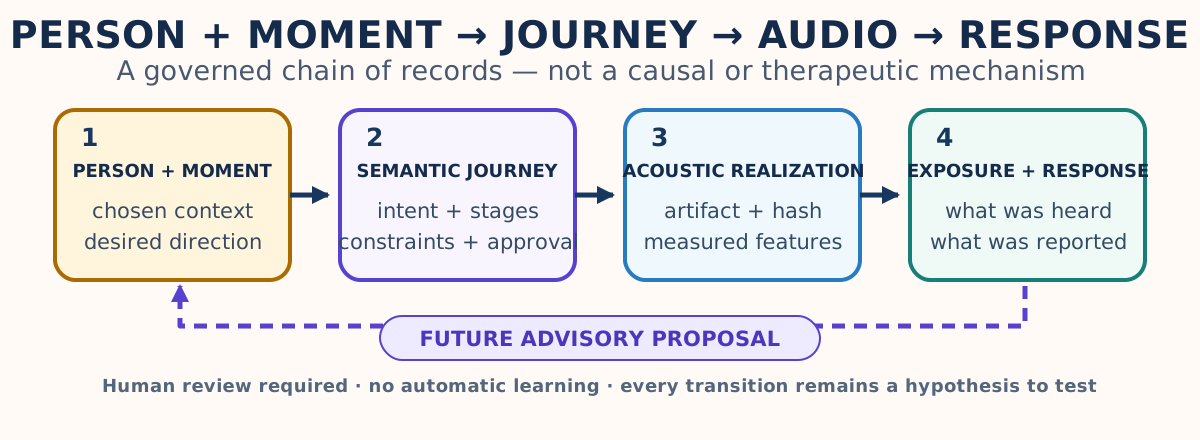
Figure description: Four numbered cards run left to right. Person and moment holds chosen context and desired direction; semantic journey holds intent, stages, constraints, and approval; acoustic realization holds the content-hashed artifact and measured features; exposure and response distinguishes what was heard from what was reported. A separate dashed return path is labeled future advisory proposal, human review required, and no automatic learning. Every forward transition is a proposed relationship to test rather than a causal or therapeutic mechanism.
Table 1 defines the evidence vocabulary used across the complete manuscript and the boundary each class must cross before it can support a stronger statement.
| Class | Meaning | Acceptable support | Promotion boundary |
|---|---|---|---|
| Source | What an external primary or authoritative source actually establishes | Primary or authoritative work plus a reviewed source record. | Supports only what the source establishes; never promotes itself to an Antidote claim. |
| Hypothesis | What Antidote proposes could be true | Scoped rationale, uncertainty, and a testable research question. | Remains tentative until qualifying observations and prespecified analysis exist. |
| Observation | What occurred in a recorded session or experiment | A qualifying artifact, protocol, measurement, or person report. | Does not become an interpretation, outcome, or generalized claim automatically. |
| Interpretation | What a person or analysis suggests the observation may mean | Explicit reasoning linked to evidence and alternatives. | Must retain uncertainty, conflict, and plausible alternatives. |
| Claim | What the manuscript or product states as supported | Ledger ID, named evidence, permitted wording, and review disposition. | Must stay within its ledger boundary; otherwise downgrade, revise, or reject. |
Each promotion is a separately reviewed decision. A generated explanation is not a source, and a synthetic fixture or compelling experience is not automatically a human-outcome result.
Table description: Rows define what each evidence class means, what artifact may support it, and which promotion step requires review. The table emphasizes that generated explanations are not sources, observations are not automatically claims, and no layer silently promotes itself to the next.
Research gap
The relevant literature does not leave an empty technical category for Antidote to fill. Longitudinal person-specific modeling, current-to-target selection, generated affective trajectories, smooth real-time feedback, interpretable musical controls, and semantic intervention planning all have documented precedent (Janssen, Broek, and Westerink 2012; Daly et al. 2016; Ehrlich et al. 2019; Agres, Dash, and Chua 2023; Zhang et al. 2026). Furthermore, a recent preliminary brain–computer music study reported nonsignificant target-emotion and time effects while person and trial variation dominated its observed variance (Monroy-D’Croz, Ramirez-Melendez, and Cespedes-Guevara 2026). Technical loop closure therefore cannot be assumed to establish reliable affective change.
Instead, our bounded review identifies an operational gap: it did not find one evaluated system that preserves, as a complete governed chain, (1) the context a person permitted for a particular purpose, (2) user-extensible semantic intent and exclusions, (3) an accepted time-indexed journey plan, (4) the generated artifact and measured acoustic realization, (5) actual exposure, (6) perceived expression, felt response, immediate usefulness or harm, and later aftereffect as separate observations, and (7) any proposed within-person update with its provenance and explicit human approval. “Did not find” is a bounded-review result, not proof that no such system exists. The proposed combination may constitute a useful research-system contribution; its global novelty, technical feasibility, learnability, and benefit remain unresolved.
This framing shifts the central question away from whether a system can infer an emotion and generate music. It asks whether a research instrument can make the entire person-and-moment audio hypothesis inspectable enough to specify, challenge, reproduce, and evaluate without promoting one record type into another.
Staged research questions
The manuscript separates a design question from two later feasibility questions:
- RQ1—design.
-
How can a local research instrument represent, generate, and evaluate a person-and-moment audio journey while keeping consented context, semantic intent, planned controls, realized acoustics, exposure, response, and longitudinal updates inspectable and non-interchangeable?
- RQ2—technical feasibility.
-
Can the implemented instrument preserve its declared authority, provenance, control-adherence, continuity, interruption, and recovery contracts across a complete local session?
- RQ3—within-person feasibility.
-
Across repeated sessions, do provenance-linked person-and-moment records support useful advisory relationships among semantic intent, acoustic realization, and self-reported response without increasing burden, surprise, mismatch, or harm?
The design/protocol manuscript is structured to address RQ1 by formalizing the research instrument and its evaluation boundary. RQ2 requires an end-to-end implemented session and auditable technical checks. RQ3 additionally requires a frozen protocol, resolved ethics and privacy gates, qualifying repeated-session observations, and uncertainty-aware analysis. Neither later question is answered by the originating experience, the literature review, a repository fixture, or the proposed architecture.
Bounded contributions
Within those limits, the complete design/protocol manuscript is scoped to five contributions at explicitly different evidence states:
it bounds the problem against prior closed-loop, current-to-target, controllable, physiologically adaptive, and longitudinal music systems rather than presenting those ingredients as new;
it formalizes an end-to-end inspectability contract that keeps consented context, semantic intent, planning, acoustic realization, exposure, response layers, provenance, and advisory updating distinct;
it proposes a two-rate adaptive-audio architecture that separates uncertain, person-correctable deliberation from deterministic generate-ahead rendering, without claiming a validated controller or seamless listening experience;
it requires a local-first authority model in which context use, plan acceptance, generation, playback, retention, export, and personal-model updates remain interruptible and human-correctable, while distinguishing the partially implemented mock path from proposed runtime behavior; and
it specifies prospectively an evidence-disciplined feasibility boundary that retains null, negative, missing, interrupted, and adverse observations and never substitutes intended control, acoustic adherence, perceived expression, felt response, usefulness or harm, or aftereffect for one another.
The remainder of the manuscript locates these contributions in prior work, formalizes the system and its mathematical objects, specifies the prospective feasibility method and results boundary, discusses only evidence-proportional interpretations, states limitations and ethical constraints, and records availability and reproducibility conditions before concluding with the gates required to revisit RQ2 and RQ3.
System design
Antidote is designed as an inspectable research instrument, not as an opaque audio recommender or an autonomous affect controller. Its unit of inquiry is a person encountering a particular acoustic realization in a particular moment after approving the context and journey that informed it. The architecture therefore preserves each transformation—source record, working projection, semantic intent, journey plan, model conditioning, generated artifact, measured acoustics, exposure, response, and any later update—as a separately identified object. This section addresses RQ1 by defining that chain and the authority, timing, uncertainty, and failure boundaries around it.
The equations below are a design language. Each is visibly classified as definitional, conceptual, a proposed operationalization, an estimated model, or a future empirical model. A definition names records without asserting a causal law. A conceptual equation transfers a useful structure from another field. A proposed operationalization states a quantity that could be implemented and tested. An estimated model produces an uncertain system view rather than ground truth. A future empirical model is neither fitted nor used by the present prototype. Appendix 13 centralizes the notation, and Appendix 14 records the status and prohibited inference of every equation.
Person–moment conditional model
Let index an individual and a decision point within or between sessions. Antidote does not represent the person as a fixed feature vector. Instead, it defines the information available for one bounded moment as the heterogeneous record ANT-EQ-001—Definitional; implementation: represented in the executable mock slice.
Here contains explicit check-in observations, contains any separately consented optional observations, is the reviewed context projection, is the desired journey, contains direct semantic-control settings, and denotes eligible prior evidence. Equation [eq:moment-record] is a tuple, not a sum: its members need not share units and none is silently converted into “the person’s state.” Missing optional observations remain missing. The same individual may therefore produce different moment records at two times, and the same audio may be associated with different responses without either response being treated as anomalous.
The desired journey is a direction and time-indexed proposal—for example, staying with, softening, exploring, releasing, focusing, or closing— rather than a promised terminal state. The current schemas permit compact valence, arousal, intensity, and confidence fields, but preserve free-text description because a low-dimensional affect coordinate cannot exhaust the person’s meaning. Likewise, prior history is eligible evidence only when its retention and learning permissions remain active and the person accepts its relevance to the present moment.
Inspectable record chain
The context boundary separates retained source records from replaceable interpretations. Following the repository’s personal-model contract, the context state is defined as ANT-EQ-002—Definitional; implementation: append-only events and derived projections exist for the executable mock slice.
where is the consented source-event record, contains derived projections, and contains their versions and provenance. This partition is compatible with local-first and event-derived views, but neither local storage nor an append-only history proves privacy, truth, or correct interpretation (Kleppmann et al. 2019; Lin et al. 2026). A current consent grant then constrains the view used for a declared purpose: ANT-EQ-003—Proposed operationalization; implementation: manual session-scoped projection is enforced in the executable mock slice.
The projection operator may select, minimize, summarize, or omit records, but it must preserve source-event identifiers, derivation version, purpose, review state, expiry, and any person-authored edit or exclusion. Revoked, expired, excluded, or out-of-purpose fields do not enter the working view. The source events remain distinguishable from the projection so a new derivation can be audited without rewriting what was originally authorized. Consent to inspect, project, generate, retain, learn, export, and publish remains separate; manual semantic entry remains usable without historical context.
The record chain continues from the accepted working projection to an immutable moment record, a versioned journey-plan revision, an approved generation specification, a generation attempt, a content-hashed artifact and feature report, an actual exposure, and separated response observations. No skipped link is inferred from a later one: generating an artifact does not establish playback, and playback does not establish a response.
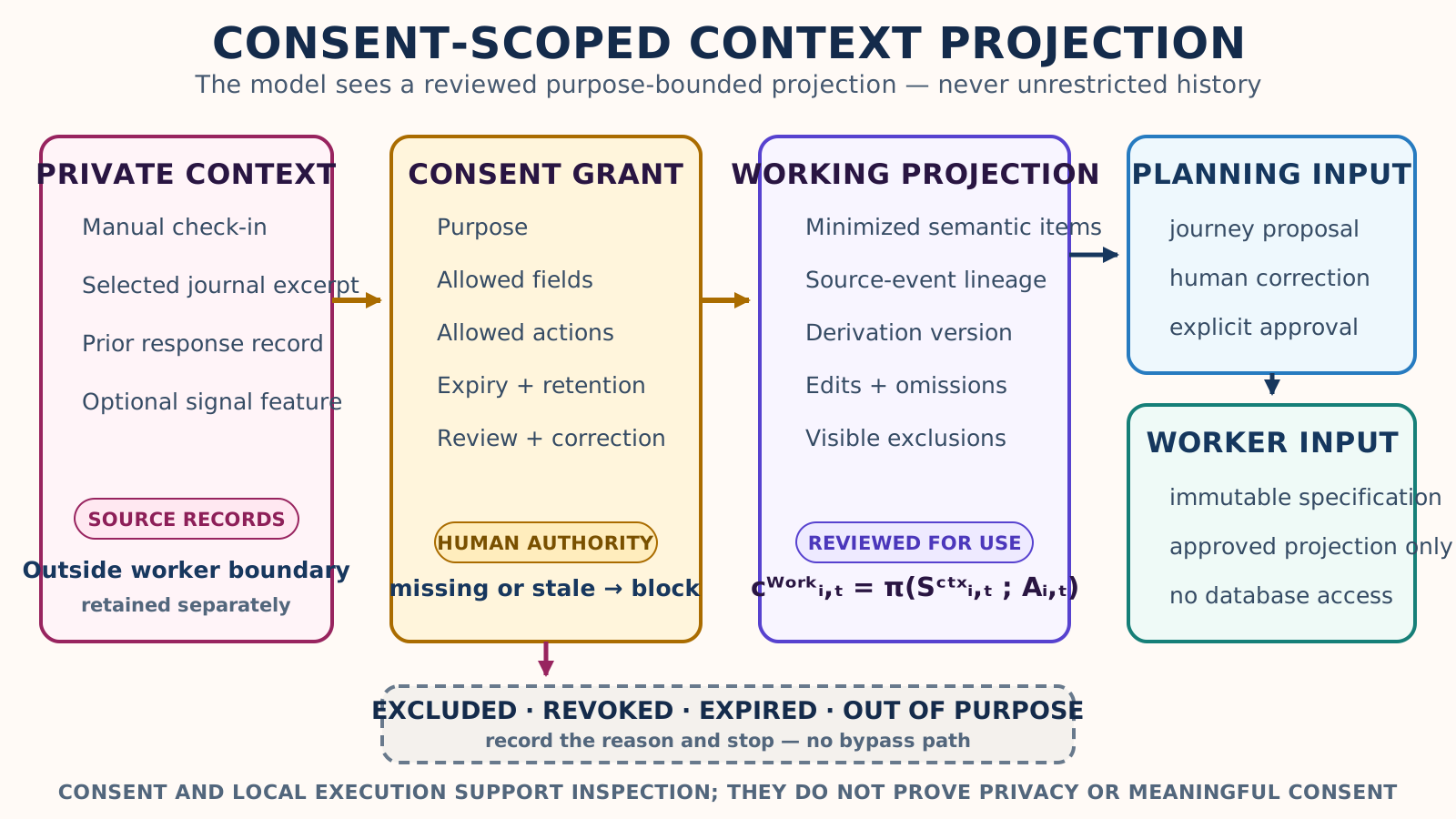
Figure description: A private context store sits outside the generation boundary. A consent grant selects purpose, fields, retention, and expiration, producing a reviewable working projection. Only that minimized projection can inform planning and the immutable generation specification. Excluded, revoked, or expired fields terminate at a blocked path rather than reaching the worker.
Semantic intent, mixins, and adapter compilation
Semantic intent is the model-independent statement of what the person wants a journey to explore. It combines a desired transition with words, metaphors, memories, inclusions, exclusions, priorities, and bounded acoustic preferences. A semantic mixin is a typed and versioned control object with a human-readable purpose, neutral position, bounds, conflicts, and adapter mapping. It is not a hidden prompt fragment and does not claim a linear mapping to acoustics or felt emotion.
For mixin , the effective normalized control is determined by an explicit authority order: ANT-EQ-004—Proposed operationalization; implementation: the generalized mixin control surface is not implemented.
An inferred value has no branch in Equation [eq:effective-knob]: it gains authority only through explicit acceptance. A current person-authored value therefore outranks an accepted suggestion, which outranks the neutral default. An active exclusion or safety constraint may reject a value or block a transition, but it may not silently substitute a different intent. Stop, revocation, and exclusion act immediately and are never smoothed.
For ordinary non-safety controls, a visible rate parameter may reduce jitter: ANT-EQ-005—Proposed operationalization; implementation: control smoothing is not implemented or perceptually validated.
Both and are dimensionless. The rate , neutral zone, and maximum rate of change are mixin-specific, visible policy rather than model invention. Smoothing can reduce control jitter; it cannot prove a smooth musical transition or a helpful experience.
The resulting semantic condition for journey stage is ANT-EQ-006—Definitional; implementation: the typed generalized composition remains formalized only.
where denotes typed composition, contains active exclusions and constraints, and records the visible precedence order used to resolve conflicts. The operator cannot be interpreted as numerical addition or raw text concatenation. Human-scale controls may be grounded in established conditioning dimensions such as tempo, key, chord, and beat, while remaining separate from the model’s native prompt representation (Melechovsky et al. 2024; Tal et al. 2024).
The accepted journey plan remains model independent. A replaceable adapter compiles one stage against the adapter capability set : ANT-EQ-007—Proposed operationalization; implementation: only the immutable mock generation boundary is executable.
The conditioning state records model-native controls, conflicts, downgrades, exclusions, uncertainty, and provenance. The prompt projection is merely one adapter-specific projection of ; it is not the journey plan or the canonical semantic record. An unsupported control must produce a visible downgrade or failure before generation. The person may accept the revised specification, change the plan, choose another compatible adapter, or stop. This separation permits model comparison without rewriting Antidote’s domain language and recognizes that requested conditions are not guaranteed to be realized by current generators (Melechovsky et al. 2024; Tal et al. 2024).
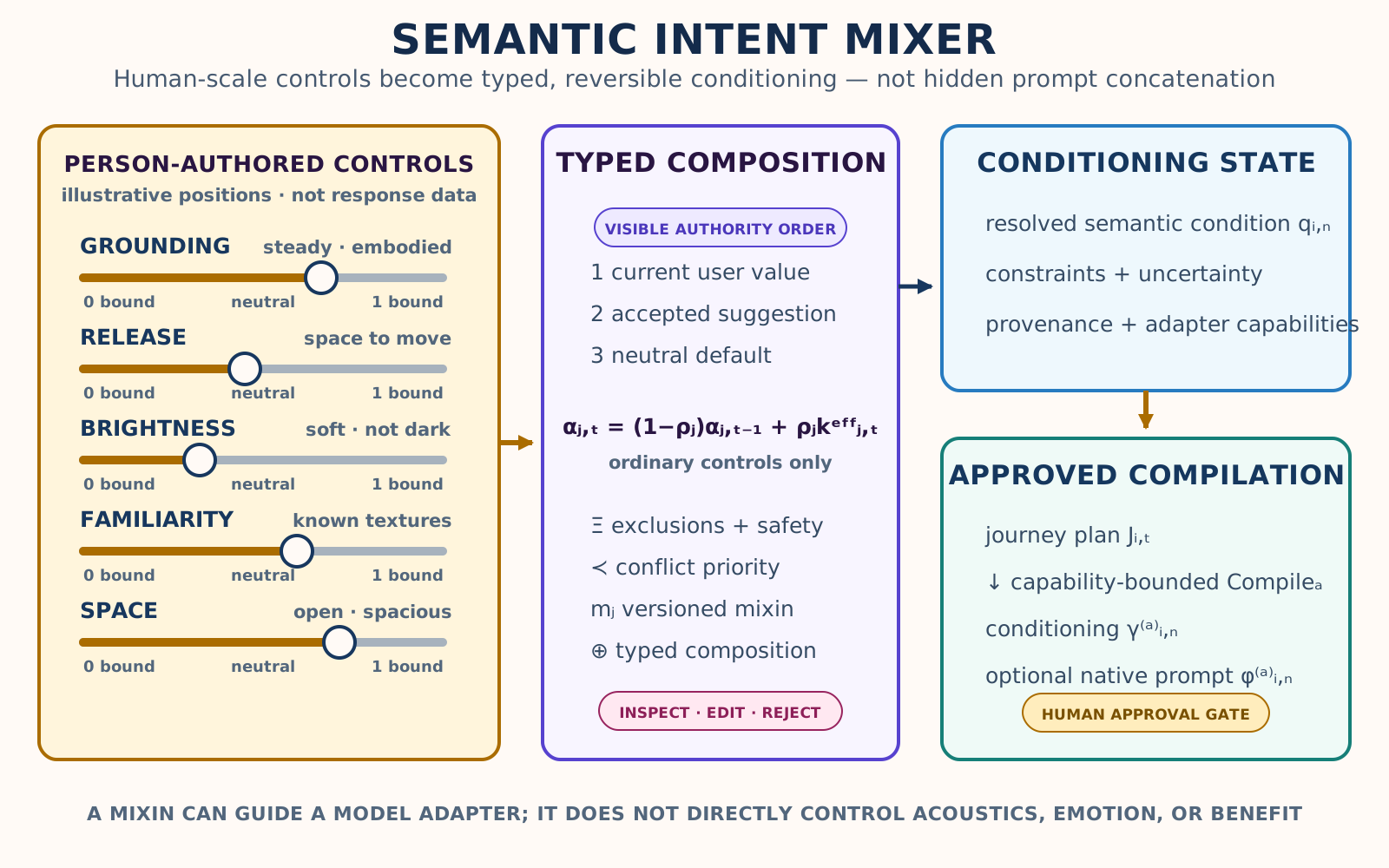
Figure description: Several semantic mixin cards expose a human-readable purpose, current value, neutral position, bounds, exclusions, priority, and adapter mapping. The cards combine into a versioned conditioning state that the person may inspect, correct, accept, or reject before generation. No arrow claims that a mixin directly causes an emotion.
Two-rate architecture and authority
The proposed architecture uses two clocks because model deliberation and audio rendering have different timing and authority requirements. A slower deliberative loop operates at meaningful decision points. It may inspect authorized observations, maintain alternative state hypotheses, combine person-authored intent, propose a short journey horizon, and request future generation. Every material change remains visible and correctable. A faster deterministic audio loop schedules already verified material, applies bounded gain and transition curves, tracks playback, and responds immediately to stop or underrun conditions. It does not infer psychology or rewrite semantic intent. Control-rate and render-rate separation has normative and neighboring-system precedents, but does not establish Antidote’s conformance or response quality (World Wide Web Consortium 2024; Hutchings and McCormack 2020; Ehrlich et al. 2019).
Authority crosses these loops asymmetrically. The person chooses context, desired journey, mixins, plan acceptance, generation, playback, retention, export, and whether evidence may inform a later proposal. The Rust domain core enforces those transitions and owns the canonical session record. A model worker receives only an approved generation specification and cannot read the database, change the personal model, initiate playback, or publish an interpretation. The renderer may halt or fall back when a deadline or safety condition fails, but cannot silently choose a new emotional goal.
At the source revision identified in this manuscript’s build provenance, an executable synthetic slice already composes a React/Tauri interface, Rust session authority, session-scoped context review, deterministic Level-1 journey planning, SQLite events, a supervised mock worker, verified synthetic WAV production, deliberate playback state, response capture, and safety halts. This is repository evidence, not human-outcome evidence. The generalized Semantic Intent Mixer, probabilistic state estimation, receding-horizon controller, generate-ahead queue, continuity engine, real music model, measured control adherence, privacy-reviewed export, optional sensors, and autonomous adaptation are not implemented. The governed final-figure specification requires both groups to be labeled so the proposed system cannot borrow credibility from the mock path.
“Closed loop” therefore names a governed possibility for later evidence to inform a new proposal. In v0, planning is rule guided, responses are recorded, and a personal-model change requires a separate evidence-linked proposal and human acceptance. The worker and controller have no autonomous learning authority.
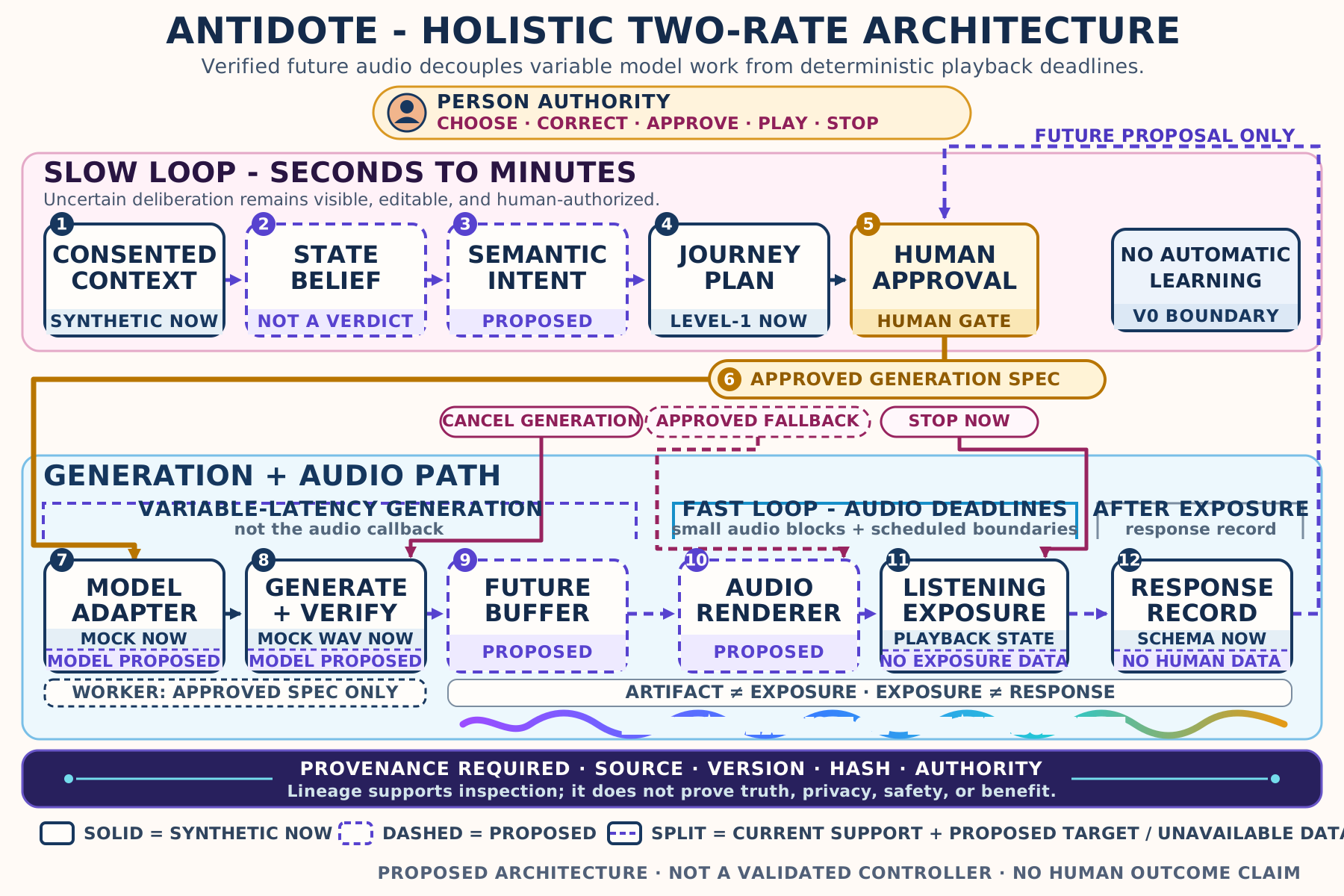
Figure description: The numbered path begins with consented context, a correctable state belief, semantic intent, a journey plan, and explicit human approval. Approval produces one immutable generation specification that crosses into a capability-scoped model adapter. Variable-latency generation and verification prepare future audio before the proposed deterministic renderer consumes small audio blocks and segment boundaries for a deliberate playback path. Exposure remains a separate record of what was actually heard, and a response remains a separate observation that can return only as a dashed future proposal requiring human review; no automatic learning path exists. Solid cards identify the executable synthetic slice, dashed cards identify proposed capabilities, and split cards distinguish current mock or schema support from target behavior. The listening/exposure and response cards are split because playback state and response schemas exist while no qualifying human exposure or response is observed. Separate cancel, approved-fallback, and immediate-stop paths bypass semantic deliberation. The provenance spine requires source, version, hash, and authority lineage while explicitly making no claim of truth, privacy, safety, benefit, hard-real-time generation, or human outcome.
State belief, receding horizon, and generate-ahead buffer
Real-time evaluation begins with observations rather than a verdict about what the person needs. Let contain only provenance-linked explicit reports, control changes, playback actions, and optional signals authorized for the current purpose. A candidate state estimator may retain alternatives as a belief distribution ANT-EQ-008—Estimated model; implementation: no state estimator or sensor path exists in v0.
Equation [eq:belief-state] transfers belief-state notation from planning under partial observation; Antidote does not claim to implement a POMDP or to observe a hidden true emotion (Kaelbling, Littman, and Cassandra 1998). The state space, observation model, calibration, and confidence representation remain study questions. Person correction changes the system record and outranks the model view. Conflicting, missing, stale, or out-of-distribution observations should widen uncertainty or suspend a proposal rather than create false precision. Reviews of passive monitoring and electrodermal affect models reinforce this validation burden: missingness, feature variation, small samples, limited generalizability, and weaker valence inference constrain any future sensor use (De Angel et al. 2022; D’Amelio et al. 2025).
At a decision point, a conceptual receding-horizon planner may compare a sequence of semantic and musical control proposals: ANT-EQ-009—Conceptual; implementation: v0 uses a deterministic rule-guided planner rather than this optimizer.
The admissible set is constrained by active consent , exclusions and safety rules , and adapter capabilities . The four barred terms are normalized, dimensionless design costs: represented journey mismatch, control change, uncertainty or risk, and interaction burden. Their weights are therefore dimensionless policy choices, not learned clinical utilities. is a planning estimate, not a predicted lived state. Only the first proposed action is shown; nothing is committed until the person approves it, after which the system observes and may replan. This is an MPC-inspired transfer under JITAI-like decision points, not a stability, optimality, intervention, or affect-dynamics claim (García, Prett, and Morari 1989; Nahum-Shani et al. 2018).
Generation must also finish before its audio is needed. If is the verified playable buffer in seconds, the proposed readiness condition is ANT-EQ-010—Proposed operationalization; implementation: generation latency and a generate-ahead buffer are not yet benchmarked.
Every term in Equation [eq:buffer-deadline] is measured in seconds; is an uncertainty margin derived from the declared hardware, adapter, and latency distribution. If the condition fails, the renderer uses a previously approved continuation, loop, ambient bed, or graceful ending. It does not insert unverified bytes or block the audio callback. Emerging streaming-generation work makes changing-input, chunk-wise generation a plausible future adapter, but does not establish local performance or production readiness (Wang, Bao, and Han 2026).
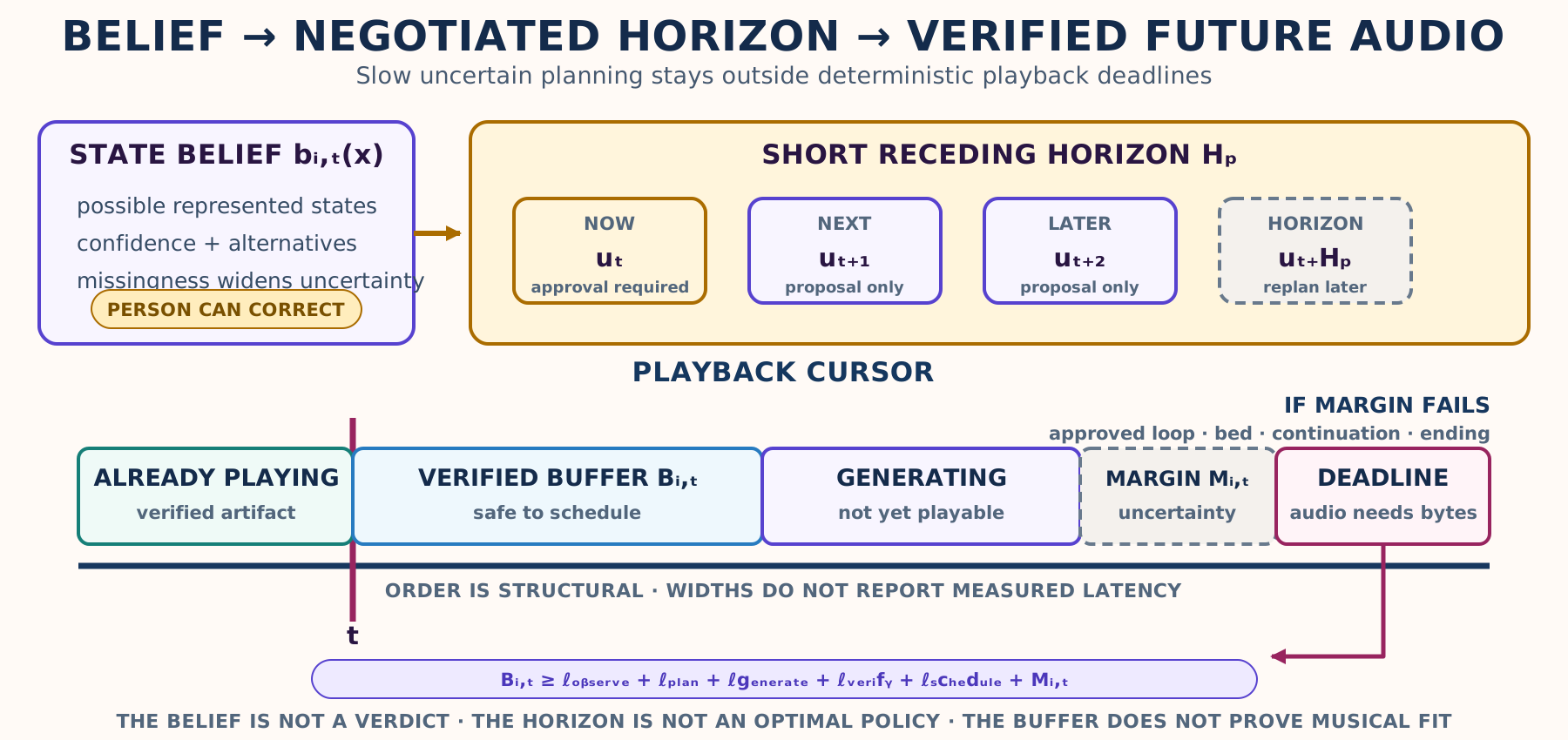
Figure description: A time axis shows the current playback cursor, verified buffered audio, generation in progress, and a future planning horizon. Above it, an uncertain state belief is corrected by the person before the next plan is accepted. Deadline and safety margins are marked independently from claims about subjective response or model quality.
Semantic, musical, and waveform continuity
A continuously changing prompt does not by itself produce a continuous listening experience. Antidote therefore separates three questions: whether neighboring semantic conditions change within their declared bounds, whether the realized audio is musically and acoustically compatible at a boundary, and whether the renderer joins verified samples without a signal discontinuity.
For adjacent stages and , semantic-plan distance is ANT-EQ-011—Proposed operationalization; implementation: no validated semantic-distance function is selected.
where is a versioned, dimensionless distance over compatible typed controls and stage roles. It must expose which mixins contributed to the distance and cannot assume that interpolation in embedding or prompt space is perceptually linear.
Measured acoustic-boundary distance is independent: ANT-EQ-012—Proposed operationalization; implementation: the mock analyzer does not validate musical boundary continuity.
The feature family may include normalized distances for tempo and beat phase, key or chord compatibility, loudness, spectral balance and timbre, density, and phrase-boundary alignment. The are nonnegative, dimensionless, and versioned; the feature-specific functions normalize otherwise incompatible units before aggregation. Thresholds for and require perceptual and technical evaluation and may differ by person or listening context. Loudness standards can anchor measurement practice without supplying a universal transition or hearing-safety threshold (European Broadcasting Union 2023).
Within an accepted overlap window , one waveform-level candidate is the equal-power crossfade ANT-EQ-013—Proposed operationalization; implementation: no adaptive continuity renderer exists in v0.
Both input signals and share the same sample-amplitude units. The equation can reduce a gain discontinuity; it cannot repair incompatible meter, phase, harmony, phrase, timbre, meaning, or emotional pacing. Resequencing, reorchestration, continuation generation, stem mixing, and a graceful ending are separate strategies. A transition is eligible for playback only after its artifact integrity, buffer margin, semantic condition, acoustic measurements, and relevant safety constraints pass their own checks. Failure of any one check invokes an approved fallback rather than being hidden by a crossfade.
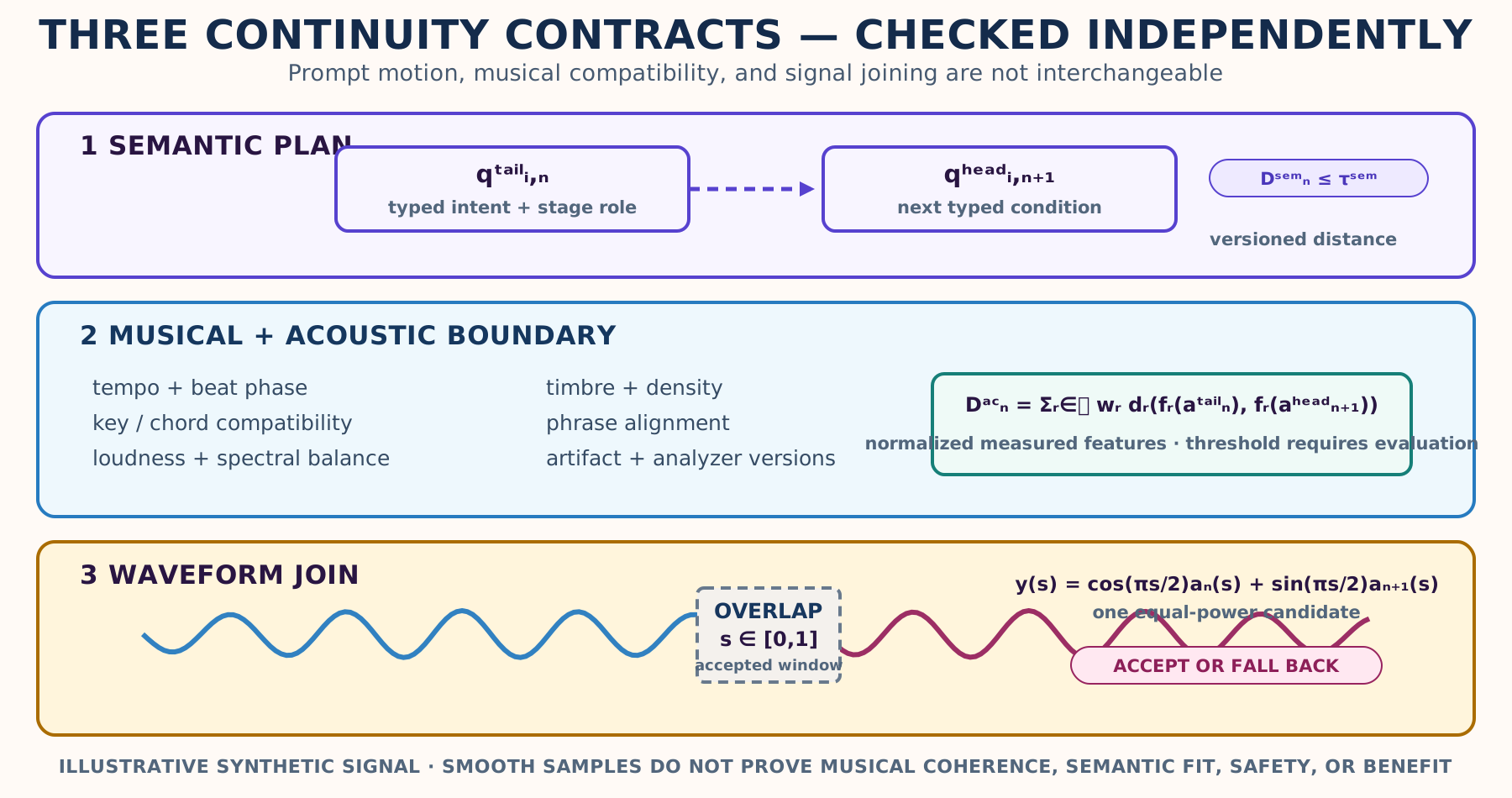
Figure description: The upper lane shows two versioned conditioning states and a bounded semantic transition. The lower lane shows adjacent audio segments, overlap or crossfade regions, waveform and feature measurements, and acceptance or fallback decisions. Separate indicators make clear that semantic similarity does not guarantee smooth audio and smooth audio does not prove intended meaning.
Exposure, response, and advisory updating
The generated segment is not the exposure . Exposure records which content hash was actually played, when playback began, duration heard, completion, interruption, stop reason, and safety events. Response is then a heterogeneous record linked to that exposure: ANT-EQ-014—Definitional; implementation: the mock slice captures a bounded subset and keeps exposure separate.
The components describe perceived musical expression, felt state, intensity, whether that intensity was wanted, immediate helpfulness, possible harm, resonance, mismatch, and a later aftereffect. They may contain text, bounded scores, categorical values, or missingness, so Equation [eq:response-record] is a record declaration rather than a numeric vector. Intense crying, for example, cannot be classified as success or harm from intensity alone; the person’s appraisal, stop behavior, and later account remain separate evidence.
A future within-person response model could estimate ANT-EQ-015—Future empirical model; implementation: no response predictor is fitted or used for generation.
where parameterizes a person-specific and versioned hypothesis. Conditioning on exposure prevents an unplayed artifact from becoming response evidence. The model would need to represent uncertainty, changed meanings, missing responses, contradictory sessions, and alternative explanations; it could not infer clinical benefit from acoustic adherence or immediate affect.
If a future protocol justified Bayesian updating, a candidate posterior form would be ANT-EQ-016—Future empirical model; implementation: v0 records evidence-linked proposals and prohibits autonomous updating.
Equation [eq:personal-update] is deliberately generic: it does not specify a valid likelihood, prior, forgetting rule, causal effect, or sufficient sample size. In the current authority model, eligible observations may support a descriptive proposal, but a new personal-model snapshot is created only after the person reviews the evidence and accepts the update. Rejection preserves both the prior snapshot and the rejected proposal. The design follows an interactive-machine-learning rationale while retaining the possibility that feedback requests can be burdensome or reduce trust (Amershi et al. 2014; Honeycutt, Nourani, and Ragan 2020).
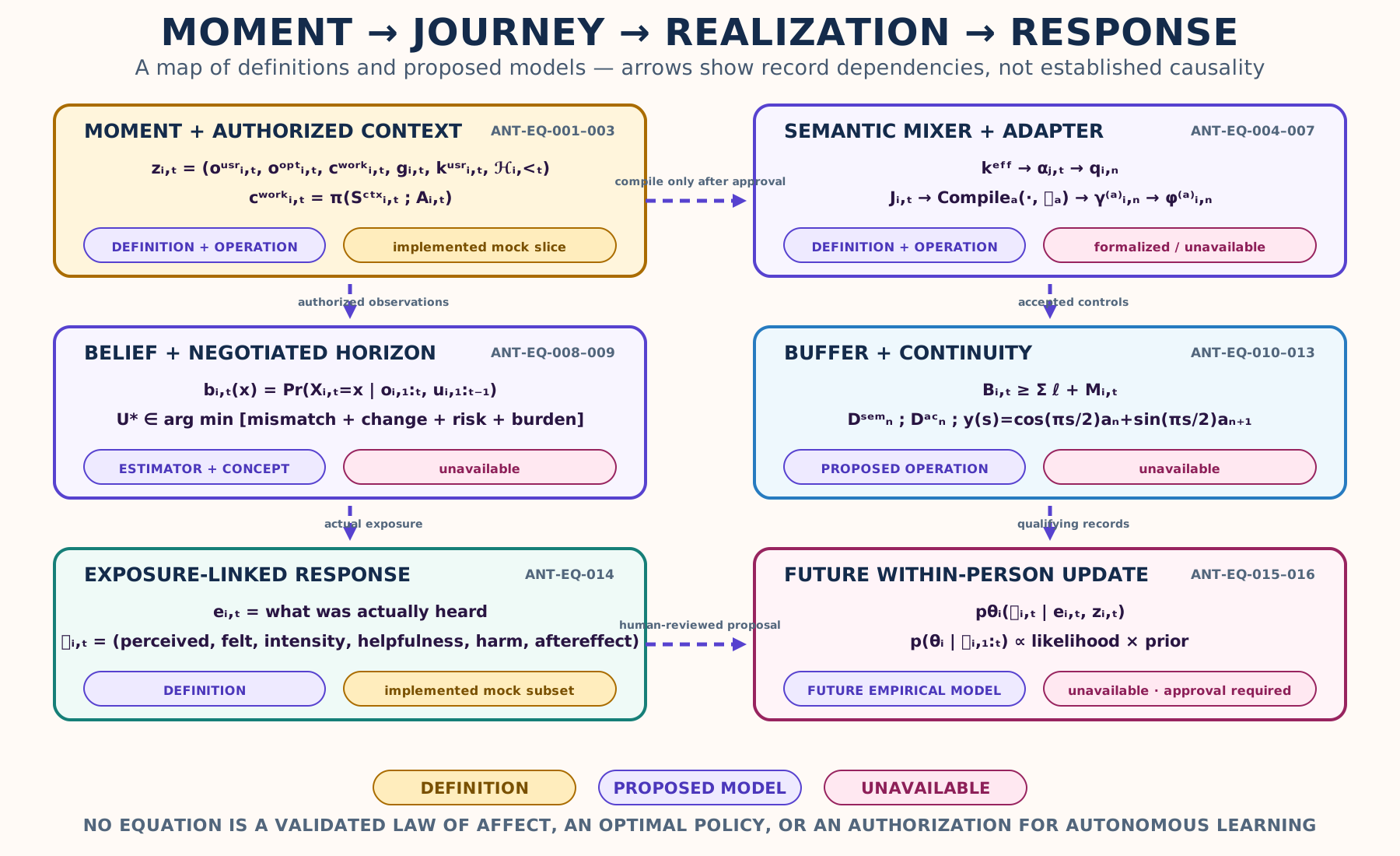
Figure description: Six cards cover all 16 registered equations. They separate moment and authorized context; semantic mixing and model-specific adaptation; uncertain state belief and a negotiated planning horizon; buffer and independent semantic, acoustic, and waveform continuity; exposure-linked response; and a future within-person update. Each card states its epistemic class and implementation status. Dashed arrows show record dependencies rather than established causality, and the final warning rejects any reading of the equations as validated affect laws, optimal policies, or authorization for autonomous learning.
Provenance and failure boundaries
Every derived record links to the activity, agent, version, and source records that produced it. For generation this includes the accepted plan hash, adapter and model identity, code revision, effective parameters, seed when supported, device class, elapsed time, warnings, downgrade decisions, output hashes, and feature-analyzer versions. For exposure and response it includes the artifact hash, playback interval, interruption state, observation window, instrument version, missingness, corrections, and permission for later use. W3C PROV supplies an interoperable vocabulary for entities, activities, agents, and derivations, while Workflow Run RO-Crate demonstrates a packaging pattern for computational lineage (Moreau and Missier 2013; Leo et al. 2024). Antidote proposes to use those concepts; a provenance record remains an assertion to audit, not proof that its interpretation is true.
The system fails closed at the boundary whose precondition is missing. Invalid, expired, or ambiguous consent prevents projection. Conflicting mixins or an unsupported capability prevent compilation until the conflict or downgrade is reviewed. A worker crash, malformed response, timeout, partial output, path violation, size violation, or hash mismatch cannot become a playable verified artifact. A missed generation deadline invokes an approved fallback. A stop, reported harm, or safety event halts automatic continuation and is never scored as engagement. A failed or rejected model update preserves the prior snapshot. An export remains blocked when classification, minimization, redaction, consent, privacy review, or destination approval is incomplete.
Append-only events make those transitions reconstructable, while separately classified payloads permit future retention and deletion policies to act on sensitive content. The present repository implements integrity and replay for the synthetic path; encryption, key recovery, backup, secure deletion, projection invalidation, real-model sandboxing, and privacy-reviewed research export remain unresolved. Local execution and content hashes reduce some dependencies and improve traceability, but they do not establish security, ownership, meaningful consent, safety, or benefit.
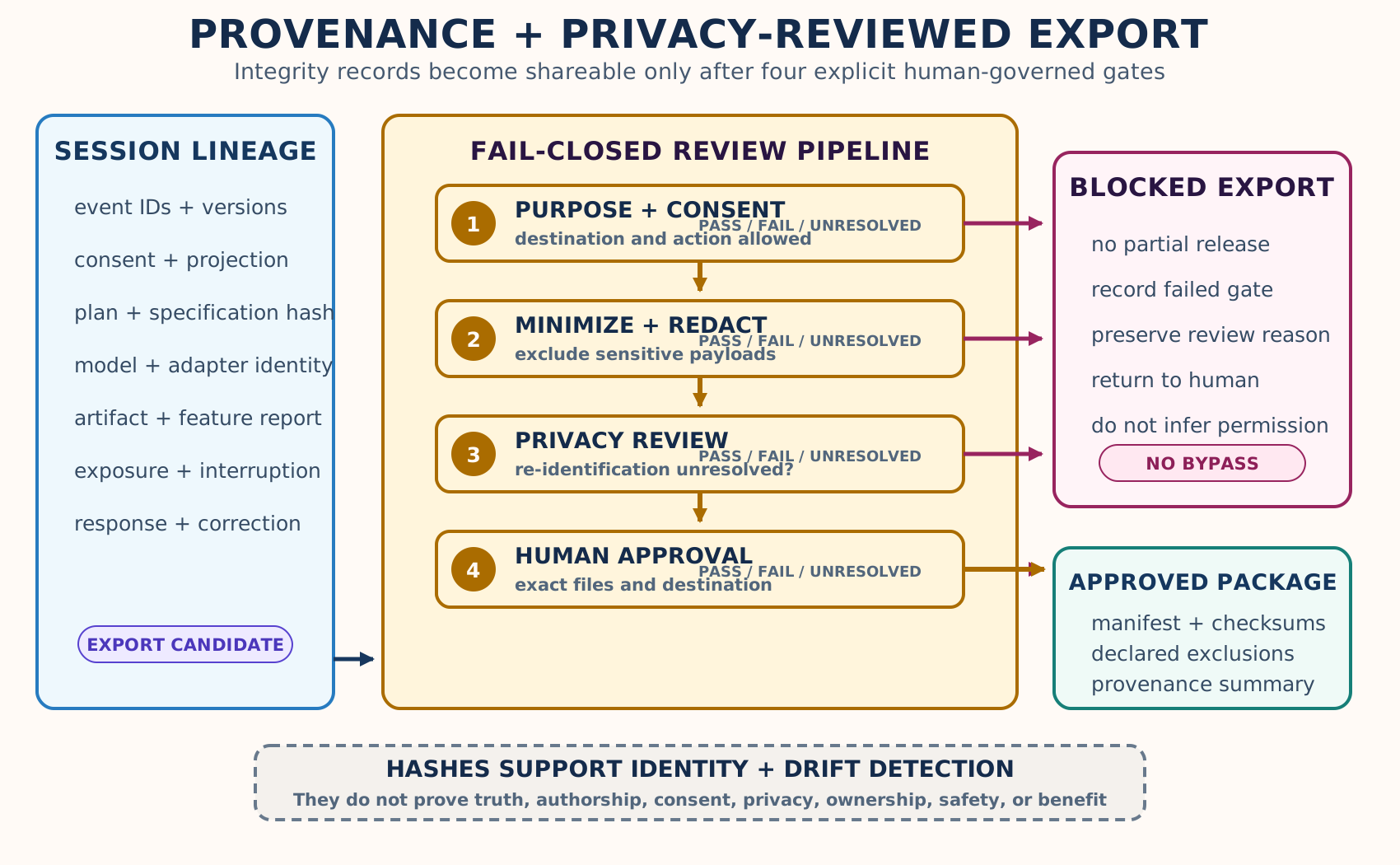
Figure description: Versioned session events, model identity, control records, exposure, response, and artifact hashes feed an export candidate. Four gates check purpose and consent scope, excluded or sensitive fields, privacy review, and explicit human approval. Any failed or unresolved gate stops export and records the reason; a successful path emits a manifest and checksums without asserting truth or safety.
Methods
This paper specifies a prospective design and feasibility protocol
rather than a clinical efficacy study. The canonical machine-readable
artifact is ANT-PROT-FEAS-001, version 1.1.0, frozen on
2026-09-07 with status frozen-design-protocol. Issue #82
created this pre-collection corrective successor after identifying an
assignment-space error and several underspecified analysis and response
rules in version 1.0.0. The exact 1.0.0 bytes remain in
antidote-feasibility-v1.json and are identified by SHA-256
dbedbcbb74303373a7e00e95ad063b0
25d8cf6033864f4ad5a390d15703ba403. No qualifying record,
exposure, or human collection began under that version; accordingly, no
formal human study has begun. Version 1.1.0 therefore changes no
observed result. Its merge likewise grants no collection authority: all
human-collection activation gates remain unsatisfied, and no ethics or
safety approval is presumed. The design draws on N-of-1 protocol
guidance for prospective specification and complete reporting, pilot and
feasibility guidance for separating practicability from efficacy, and a
digital N-of-1 platform as an implementation precedent (Porcino
et al. 2020; Eldridge et al. 2016; Konigorski et al. 2022). Those
sources inform reporting discipline; they do not validate Antidote’s
measures, conditions, software, or proposed use.
Planned measurement layers
The protocol preserves intended semantic controls, model and adapter identity, generation settings, output identity and checksum, measured acoustic features, actual exposure, baseline and target states, separated subjective responses, timestamps, protocol version, and mutations between trials. These layers are non-interchangeable. A requested control is not a realized acoustic property; a measured acoustic property is not perceived expression; perceived expression is not felt state; and emotional intensity, completion, or engagement is not evidence of usefulness, harm, or clinical benefit. Behavioral or physiological measures are optional extensions and cannot become the sole definition of a person’s experienced state.
Evidence classification
Research records use five non-interchangeable classes:
source for what external evidence establishes,
hypothesis for what the project proposes,
observation for what occurred,
interpretation for a bounded explanation of an
observation, and claim for a statement supported in the
manuscript. The working claim ledger is maintained outside publication
artifacts under research/notes/. Synthetic fixture output
and repository tests remain technical observations; they are not
participant data.
Research questions and feasibility stages
The protocol maps the three research questions to four evidence
stages. D0 addresses RQ1 through design traceability: each
transformation and authority boundary must resolve to a versioned
record, equation, contract, or explicit unavailable state. T0 addresses
the implemented portion of RQ2 with synthetic, deterministic conformance
and recovery tests. T1 would extend RQ2 to a frozen real-model, adapter,
analyzer, hardware, and mutation manifest, but is currently
blocked-no-real-model. H1 would address the
record-feasibility prerequisite to RQ3 through a prospective
repeated-session within-person series, but is
blocked-no-collection-authority. Passing D0 or T0 neither
implies that T1 will pass nor authorizes H1. H1 can test only whether
separated records can be collected, corrected, retained, and
provenance-linked with auditable completeness, voluntary-response
usability, burden, and safety-event accounting. That is a prerequisite
for RQ3, not a test of useful advisory relationships. Likewise,
technical controllability cannot establish that an exposure is
subjectively fitting, useful, safe, or therapeutically effective.
Units, conditions, and session structure
The technical unit is one immutable generation specification and its terminal result; the human-response unit is one assigned session attempt, with an exposure counted only when a verified artifact is actually played. The proposed H1 series contains six blocks and three conditions per block, for 18 planned completed exposures and an absolute ceiling of 24 scheduled attempts. Each artifact targets eight minutes. Exposures are separated by at least 48 hours, limited to three in any seven days, and followed by an aftereffect window targeting 24 hours (acceptable range 18–30 hours).
Condition G is a generic instrumental ambient generation that receives neither current state, desired transition, nor personal context. Condition S receives only selected current-state and desired-transition categories and a frozen meet–hold–transition–integrate template; it receives no free-text history, personal descriptors, or prior-session mappings. Condition P receives the explicitly approved working projection, person-authored semantic mixins, inclusions, exclusions, and an editable journey plan. Across conditions, a qualifying execution would hold constant the immutable model revision, adapter and analyzer versions, hardware profile, duration, output format, playback setup where feasible, response-instrument version, and file target of LUFS integrated loudness with a dBTP true-peak ceiling. File-level normalization neither determines sound-pressure level at the ear nor establishes hearing safety; playback begins at the lowest device level and remains under the person’s control. Auditory beats, within-exposure adaptation, and personal- model updating are excluded from this protocol.
These are visibly different condition-and-interface bundles. They jointly vary context fields, desired-transition use, personal semantic content, plan visibility, editing, and—for P—negotiated approval. Randomization permits only within-person contrasts among those bundles. It cannot isolate personalization, a semantic field, plan editing, approval, or a psychological or neurological causal pathway.
Each prospective session follows eight governed steps: authority and readiness; baseline and desired transition; condition reveal and plan review; generation and verification; a separate, explicit playback action; immediate response within five minutes; later aftereffect report; and closure or pause. A generated but unplayed artifact never enters an exposure or human-response denominator. The current desktop MVP is not this H1 instrument, and records produced through its schema-generation v1 runtime payloads are not H1-eligible. H1 remains blocked until, at minimum, the timed session workflow, separate version 2 consent enforcement, version 2 response and correction contract, assignment and seed enforcement, participant-facing instrument, safety workflow, and minimum-data private research export have been implemented and independently reviewed.
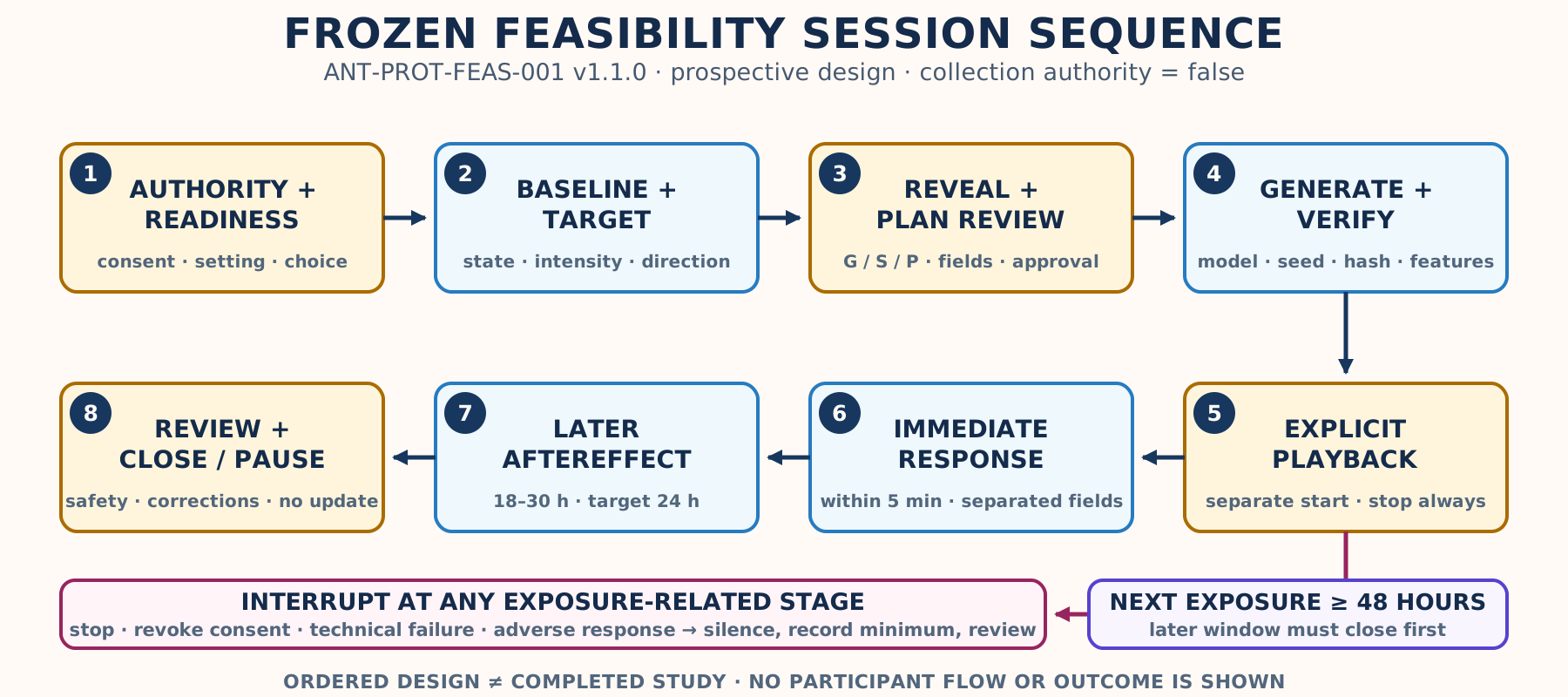
Figure description: The timeline begins with protocol version and consent confirmation, then baseline and desired trajectory, plan review, generation and artifact verification, explicit playback approval, exposure with stop controls, immediate separated response measures, a declared aftereffect interval, and later review. Safety events may interrupt the sequence at every exposure-related stage.
Technical verification
T0 verifies the mock system’s authority, schema, replay, interruption, recovery, hashing, and provenance invariants with complete denominators. T1, if activated after implementation review, freezes a real-model qualification manifest before any qualifying run. Its planned matrix contains three baseline runs, 24 one-factor mutation runs, six adjacent-segment continuity runs, and six injected failure-and-recovery runs: 39 attempts if all declared controls are supported. The fixed seeds are 101, 307, and 911.
The one-factor pairs vary tempo (70 versus 100 BPM), normalized density (0.25 versus 0.65), timbral instruction, or semantic intent while holding seed, model, adapter, hardware, duration, output format, base plan, and all other controls constant. Tempo and density require versioned measured outputs. Timbral comparison requires a named analyzer and uncertainty. Semantic mutation is verified only as an adapter-conditioning trace unless an independently specified measure exists; it is not relabeled as acoustic adherence. Unsupported controls remain unsupported rather than being silently substituted.
The technical measures are authority-state conformance, required provenance completeness, component latency and verified buffer margin, requested-versus- measured control adherence, semantic and acoustic boundary distances, and terminal generation state. They correspond to the consent projection, adapter, generate-ahead, continuity, and response-record equations (ANT-EQ-003, ANT-EQ-007, and ANT-EQ-010–ANT-EQ-014). Hard gates require all invalid or unapproved transitions to fail closed; every playable artifact to match its declared hash, format, and bounded path; cancellation, timeout, stop, and safety halt to reach recorded terminal states; and no missed deadline, partial output, or unsupported control to be reported as success. Hardware- and adapter-specific latency, buffer, analyzer, and perceptual thresholds must be frozen in the later T1 manifest; this paper invents no universal threshold. For each registered component latency and verified buffer-margin variable, reporting fixes , minimum, maximum, the ordinary arithmetic median, and , , and . Quantiles use fixed linear interpolation: , , , and , with the upper index capped at . Values are calculated from unrounded seconds separately for each component and terminal state. These summaries remain descriptive rather than universal thresholds.
Within-person feasibility measures
The proposed H1 instrument uses brief, near-event self-report because ecological momentary assessment can reduce recall distance while introducing its own burden, reactivity, adherence, and missingness concerns (Shiffman, Stone, and Hufford 2008). Baseline captures a person-authored description plus valence, arousal, and intensity; desired transition remains a separate nominal category with a person-authored description. Those descriptions are required by the current moment-context contract. The compact valence and arousal interaction borrows from the Affective Slider (Betella and Verschure 2016), but Antidote’s wording, intensity, response timing, and additional items constitute a new protocol and are not validated by that source.
After exposure, the instrument records perceived musical expression
separately from felt state. It then records whether the intensity was
wanted, as well as helpfulness, resonance, mismatch, harm, surprise,
interaction burden, and total session burden. Helpfulness and harm are
asked again in the later aftereffect window together with a
yes/no/unsure ongoing-effect item and optional person-authored meaning,
without overwriting the immediate record. Response descriptions are
optional in the version 2 response contract; every prompted-but-absent
response field instead receives its own field path and exactly one of
not_prompted, declined,
missed_window, technical_failure,
interrupted, or not_applicable. A correction
is a new record carrying the superseded response identifier and
correction reason.
Every subjective scale is frozen. Valence runs from “very unpleasant” through 0 “neither pleasant nor unpleasant, or evenly mixed” to “very pleasant”; arousal runs from “very low activation” through 0 “neither low nor high” to “very high activation”; intensity runs from 0 “not at all intense” to 1 “extremely intense.” Wanted intensity and ongoing effect each use the nominal responses yes, no, and unsure. Helpfulness runs from “not at all helpful for my chosen purpose” to “as helpful as I could reasonably ask for that purpose”; resonance from “did not fit or resonate at all” to “fit or resonated completely”; mismatch from “no perceived mismatch” to “extreme perceived mismatch”; harm from “no unwanted negative effect noticed” to “extreme unwanted negative effect”; and surprise from “entirely expected” to “entirely unexpected.” Interaction burden and whole-session burden are separate items, each running from “not burdensome” to “too burdensome to repeat.” No clinical outcome is collected, and no emotional direction is prespecified as inherently better. In particular, catharsis, crying, arousal, or movement toward a target cannot substitute for the person’s appraisal of whether the experience was wanted, helpful, mismatched, or harmful.
Physiology is disabled in version 1.1.0. A future supplemental module would require separate consent; device, calibration, clock, unit, signal-quality, artifact, dropout, and missingness records; a frozen analysis; and independent privacy and safety review. It could not overwrite self-report, diagnose emotion or need, prove entrainment, or steer generation under this protocol.
| Registry ID / construct | Timing / evidence | Instrument, scale, provenance | Strongest permitted boundary |
|---|---|---|---|
| person-authored current state | pre-condition | Text + valence/arousal [-1,1] + intensity [0,1]. | Not an objective emotion, diagnosis, or need. |
| desired transition | pre-condition | Selected category + required text; nominal, not ordinal. | Not a promised endpoint or clinical goal. |
| requested semantic intent and plan | pre-generation | Approved projection + plan revision; typed edits and exclusions. | Requested controls are not realized acoustics or felt response. |
| generated acoustic realization | post-generation-pre-exposure | Artifact verifier + feature analyzer; feature-specific units and warnings. | Measured features do not reveal perceived expression, felt state, usefulness, harm, or benefit. |
| actual exposure | during playback | Playback event; artifact hash, timestamps, seconds heard, and stop state. | A generated but unplayed artifact is not an exposure. |
| emotion or meaning perceived in the audio | immediate | Optional text + valence/arousal [-1,1] + intensity [0,1]. | Perceived expression is not the listener’s felt state. |
| felt response | immediate-and-later | Optional text + valence/arousal [-1,1] + intensity [0,1]; field missingness. | Felt state is not automatically helpful, harmful, or clinically meaningful. |
| wanted intensity, helpfulness, resonance, mismatch, harm, and surprise | immediate; helpfulness and harm repeated later | Wanted intensity yes/no/unsure; helpfulness, resonance, mismatch, harm, surprise [0,1]. | Intensity, crying, completion, or engagement is never substituted for helpfulness or harm. |
| interaction and whole-session burden | immediate | Interaction burden + whole-session burden [0,1]. | Low burden does not establish benefit or meaningful consent. |
| ongoing effect and optional person-authored meaning | baseline-readiness-and-later | Ongoing effect yes/no/unsure + optional later meaning. | An ongoing effect is not presumed helpful, harmful, caused solely by the audio, clinically meaningful, or mechanistically explained. |
| unavailable or declined response fields | every collection window | Per-field reason: not prompted, declined, missed, failed, interrupted, or not applicable. | Missing is not neutral, zero, or a successful response. |
| append-only person-authored response correction lineage | whenever a response is corrected | Append-only revision, superseded response ID, and person-authored reason. | A correction preserves revision history and does not prove that either version is objectively correct. |
| clinical outcome | not-collected | No instrument; not collected; not applicable. | No feasibility field may be promoted into a clinical endpoint. |
Prospective projection of ANT-PROT-FEAS-001 v1.1.0.
Collection authority is false. Scale shorthand preserves the frozen
anchors; prompted but absent fields retain explicit missingness rather
than a substituted value.
Table description: Each row names one non-interchangeable measurement layer. Columns identify the planned instrument, collection timing, provenance fields, missing-data treatment, and the strongest permitted interpretation. Clinical outcome is shown as outside the initial feasibility protocol rather than inferred from the other rows.
Assignment, carryover, and missingness
The six possible orders of G, S, and P are each used once. Their block order is randomized with a cryptographically generated seed committed in a separate activation record before session 1. This is a bijection of six distinct orders to six chronological blocks, so the allowable schedule space is exactly . It is not six independent draws. The machine-readable protocol maps a 32-byte seed uniformly to a zero-based lexicographic schedule index using SHA-256 rejection sampling and records the counter, index, schedule, and commitment. H1 additionally fixes block seeds 101, 307, 911, 1217, 1601, and 2027 in chronological order and uses the same block seed for G, S, and P. A model or adapter that cannot honor that commitment leaves H1 blocked. The committed seed is never substituted; any pre-exposure retry retains it, and no retry is allowed after hearing or rating its output. Eligibility and baseline are confirmed before condition reveal. Participant blinding is impossible because the three interfaces disclose different context and plan operations; researcher blinding is also impossible in a self-study, and both facts must be reported. A failed assigned session remains in the attempt ledger. A replacement is allowed only before any exposure starts, retains the same block, slot, condition, and committed block seed, and never erases the failure. Once playback starts, the slot is consumed regardless of completion or response and cannot be rerun based on what was heard or reported.
At least 48 hours and completion or expiry of the later-response window separate exposures. Ongoing aftereffect, mismatch, distress, hearing discomfort, or uncertainty postpones the next attempt by at least another 24 hours and triggers a repeated readiness review. This spacing may reduce but cannot prove removal of carryover. Flagged sessions remain in primary accounting and are examined in a prespecified sensitivity analysis.
Analyses distinguish all assigned attempts, verified artifacts, started exposures, completed exposures, immediate windows, and later windows. No outcome is imputed in the primary analysis. Each prompted but absent field carries its own canonical missingness reason. Condition contrasts use only blocks containing both required observations and disclose every omitted block. Lower- and upper-endpoint values are used only for the prespecified interaction-burden progression sensitivity, never as substituted observations.
Analysis and sensitivity plan
Technical reporting includes complete state denominators, invariant outcomes, the frozen latency summaries, paired control differences by factor and seed, and every semantic and acoustic boundary component. Human-response feasibility reporting includes assigned through withdrawn counts by condition; audit completeness; usable voluntary values by field and canonical missingness reason; separate interaction- and whole-session-burden distributions; all mismatch, harm, hearing-discomfort, distress, and safety events; and the ability to link semantic, acoustic, exposure, response, and correction records through provenance. A declined response can be audit-complete but is not counted as a usable response.
Secondary within-person estimands are blockwise P-minus-S, P-minus-G, and S-minus-G contrasts for immediate helpfulness, resonance, mismatch, harm, and interaction burden and whole-session burden separately; differences between perceived-expression and felt-state valence and arousal; and condition-specific baseline-to-immediate valence and arousal changes. Protected analysis output retains every session point; the public envelope exposes only privacy-reviewed aggregate denominators, medians, ranges, and eligible blockwise contrasts. Exploratory variable-pair searches and multivariable response regressions are not run: with at most 18 exposures, neither a search nor simultaneous condition, block, order, and baseline coefficients are defensibly supported. A later protocol would have to name its variables, model, and sample-size rationale prospectively.
For a named immediate outcome and pairwise contrast, an exact randomization distribution is available only when all three chronological position values are present in all six blocks. It holds those values fixed, enumerates lexicographically all 720 bijections of the six condition orders to the six blocks, assigns labels under each schedule, and uses the mean of the six within-block A-minus-B differences as the statistic. The two-sided tail includes every unrounded statistic with absolute value at least the observed absolute value, including ties, and reports the count divided by 720. All 720 statistics are retained in the protected analysis output. A public aggregate reports the observed statistic, tail count, denominator, exact proportion, and privacy- reviewed distribution summaries; the full vector is not released without a separate field-level disclosure review and current export scope. No reduced, asymptotic, one-sided, plus-one, or multiplicity-adjusted substitute is used. This is an exploratory reference for the single person and schedule under a sharp no-bundle-effect null, not population inference or component-level causal attribution.
Sensitivity analyses compare started exposures with those reaching 80 percent of audio (384 of 480 seconds), include and exclude named carryover flags, report blocks 1–3 and 4–6 separately without treating the split as a trend test, leave out each block in turn, and stratify by administration status only if it actually changes. For missing interaction-burden values only, the progression decision is repeated once with 0 and once with 1. Audit completeness, completion, usable-response proportions, provenance, and unresolved safety are factual and cannot be rescued by bounds. Helpfulness and resonance otherwise use 1/0 as descriptive best/worst endpoints; mismatch, harm, and both burden fields use 0/1; valence, arousal, intensity, and surprise receive endpoint ranges without calling either direction better; and nominal fields are never numerically imputed. All prespecified null, zero, opposite-direction, negative, missing, interrupted, burdensome, harmful, and adverse observations remain visible. No endpoint will be selected or renamed after observation.
The progression rule is operational rather than therapeutic. A later bounded study may be considered only if the hard technical gates pass; at least 15 of 18 exposures and at least four per condition complete; every assigned attempt and scheduled window is audit-complete; and every immediate core field has at least 80 percent of the started-exposure count, rounded upward to the next whole value, overall and at least three per condition, while every later core field has at least 70 percent of that count, again rounded upward, overall and at least two per condition. Every eligible response must preserve the full protocol-to-correction provenance chain. Observed median interaction burden and both its endpoint-bound decisions must be no greater than 0.5; no safety event may remain unresolved; and the participant and an independent reviewer must separately find another bounded study acceptable. Otherwise the decision is stop or revise. Even a “proceed” decision establishes neither advisory usefulness, efficacy, generalizability, privacy, nor safety.
Equation ANT-EQ-014 defines the separated response record used here. ANT-EQ-015 and ANT-EQ-016 remain unavailable future empirical models: this protocol fits no response predictor, specifies no likelihood, and authorizes no personal-model update.
Protocol freeze, safety, and deviations
The canonical protocol, its SHA-256 lock, and an initially empty
append-only deviation log are stored under
experiments/protocols/. Before the first qualifying record,
a material change requires a new semantic protocol version, content
lock, analysis plan, and review. After collection begins under separate
authority, the frozen file is never rewritten: amendments and deviations
append the rationale, affected records, evidence impact, author,
reviewer, and disposition. Conditions, assignment, timing, measures,
estimands, exclusions, model or analyzer identity, consent, privacy,
retention, safety, physiology, and missingness rules are material
changes.
The person may postpone, pause, skip, stop, withdraw, or decline any response without penalty or automatic substitution. A stop request or consent revocation, hearing pain or unexpected loudness, unwanted escalating distress or disorientation, technical or provenance failure, or any loss of freely chosen participation stops playback and prevents automatic continuation. The interface must offer silence and a clear exit, retain only the minimum consented event, and defer optional questions until the person chooses. Urgent concerns belong with appropriate human or emergency support, not Antidote. Unresolved adverse responses, serious events, stop-control failure, or repeated high harm pause the protocol for independent review; these rules do not prove clinical safety.
For those pause rules, “high harm” means a non-missing immediate or later harm rating of at least 0.75, or an explicit request by the person to treat an event as high harm. “Repeated” means high harm associated with two distinct started exposures; immediate and later reports from one exposure count once. A “serious event” is operationally an event for which urgent or emergency human assessment is sought; reported hospitalization, persistent hearing change, or persistent functional impairment; incapacity preventing a self-directed exit; continued playback after a stop request; or unauthorized access, retention, or export of consent-scoped sensitive data. This is not a diagnosis or clinical severity judgment. An event is unresolved while it lacks a documented disposition, a reported unwanted effect remains ongoing or unsure, or required independent review is incomplete. Serious events and stop-control, privacy, or consent failures cannot close automatically.
Separate consent scopes govern inspection, projection, generation, playback, retention, analysis, export, and learning (future personal-model use). Raw journal, therapy-chat, health, or other private free text cannot enter the public repository or a default research export. Storage encryption and recovery, retention expiry and deletion, projection invalidation, backups, participant materials, the applicable ethics determination, assignment commitment, version 2 consent enforcement, protocol timing, version 2 response and correction handling, minimum-data private research export, instrument implementation, analysis code, and pilot stop/go review all remain unresolved activation gates. Consequently, this protocol is reproducible as a design artifact but is not permission to recruit, expose, collect, or report a human result.
Results
This design/protocol manuscript contains no formal human results. No qualifying formal-study or H1 package is registered. No qualifying T1 package is registered; therefore no real-model technical result is reported. The originating catharsis experience remains a hypothesis-generating observation rather than a study result. These statements describe the governed repository record, not events that might have occurred outside the protocol. The absence of a qualifying record is reported as not run, not collected, blocked, or not applicable; it is never entered as a zero.
Results reporting is governed by ANT-REPORT-RESULTS-001,
version 1.1.0. It preserves the original issue #41 governance and
records issue #82 as the prospective pre-collection amendment. The
machine-readable contract binds each future result slot to a named
source record, the byte-locked ANT-PROT-FEAS-001 protocol
version 1.1.0, a frozen analysis pointer, an evidence class, and a
claim-promotion rule. It currently registers no T0, T1, or H1 result
package. This structure adopts the complete-accounting orientation of
N-of-1 and pilot-feasibility reporting guidance—including participant
flow, missingness, harms, analysis, and progression—without describing
Antidote as a completed trial or effectiveness study (Vohra et al. 2015;
Eldridge et al. 2016).
Technical verification reporting
The D0 protocol record is available for inspection. Its identity and content lock are repository artifacts, while the reporting contract declares the intended slot, schema, equation, and activation-gate mappings. This is evidence that versioned design records and explicit mappings exist; it is not an execution result, an independent audit of implementation, or evidence of feasibility, privacy, safety, or benefit.
The repository also contains an executable synthetic session path and
its component tests, as bounded by ANT-OBS-002. Those artifacts remain
development and conformance evidence. The ANT-Q03 exit gate in issue #18
has not produced the reserved ANT-REC-T0-001 result
package, so no T0 rate, count, latency, or success claim is promoted
here. Closing an issue or observing a green workflow would not be
sufficient by itself. Promotion requires the reviewed source revision,
execution environment, exact commands, planned denominators, every
terminal state, injected failure and recovery, artifact hashes,
exclusions, and an explicit claim-ledger decision. Any accepted T0
statement must retain the labels synthetic and
technical and cannot imply a human exposure or response.
No interface capture is included in the current manuscript because
the qualifying ANT-REC-T0-001 package does not exist. The
governed visual slot is retained as retired provenance so a later
revision can reactivate it only with a reproducible reviewed build,
capture metadata, an explicit synthetic-or-approved-data label, and
redaction review. Interface presence could demonstrate that a control is
displayed; it could not demonstrate that the underlying authority is
complete or that an experience is helpful.
Control adherence and continuity
T1 remains blocked-no-real-model. No T1 qualification
manifest has frozen a specific model, adapter, analyzer, hardware
profile, technical threshold set, or run plan, and
ANT-REC-T1-001 does not exist. Consequently, the governed
table below contains source and analysis identities plus current
evidence states, but no attempt accounting, authority or
artifact-integrity invariant results, requested controls, measured
features, adherence values, latencies, buffer margins, boundary
distances, failure rates, or uncertainty estimates.
| Future result slot | Governance binding | Current evidence state |
| Mock exit-gate conformance | Source:
ANT-REC-T0-001Stage: T0Evidence
class: technical-syntheticProtocol:
ANT-PROT-FEAS-001 v1.1.0Analysis:
ANT-AN-T0-STATE-001 |
Awaiting issue #18; no qualifying package |
| Real-model attempt accounting | Source:
ANT-REC-T1-001Stage: T1Evidence
class: technicalProtocol:
ANT-PROT-FEAS-001 v1.1.0Analysis:
ANT-AN-T1-ACCOUNTING-001 |
Blocked; no qualified real model or run |
| Authority and artifact-integrity invariants | Source:
ANT-REC-T1-001Stage: T1Evidence
class: technicalProtocol:
ANT-PROT-FEAS-001 v1.1.0Analysis:
ANT-AN-T1-INVARIANTS-001 |
Blocked; no qualified real model or run |
| Real-model control adherence | Source:
ANT-REC-T1-001Stage: T1Evidence
class: technicalProtocol:
ANT-PROT-FEAS-001 v1.1.0Analysis:
ANT-AN-T1-ADHERENCE-001 |
Blocked; no qualified real model or run |
| Generation timing and buffer margin | Source:
ANT-REC-T1-001Stage: T1Evidence
class: technicalProtocol:
ANT-PROT-FEAS-001 v1.1.0Analysis:
ANT-AN-T1-TIMING-001 |
Blocked; no qualified real model or run |
| Continuity, interruption, and recovery | Source:
ANT-REC-T1-001Stage: T1Evidence
class: technicalProtocol:
ANT-PROT-FEAS-001 v1.1.0Analysis:
ANT-AN-T1-CONTINUITY-001 |
Blocked; no qualified real model or run |
Exact planned paths and protocol pointers are governed by
ANT-REPORT-RESULTS-001. No qualifying values are
registered; absent is not zero.
Table description: The generated empty-state table maps each future technical result to a source package, protocol version, and analysis identifier. The mock exit-gate row awaits issue 18, while all real-model rows are blocked because no model qualification has run. The table reports no rates, latencies, adherence estimates, boundary distances, or subjective outcomes.
If T1 is later activated, its matrix reaches 39 attempts only when every declared control is supported; otherwise reporting will name each unsupported or missing attempt and the resulting denominator. Authority and artifact-integrity invariants will each be reported as pass, fail, or unavailable rather than being inferred from an aggregate success state. Requested-versus-measured differences will be paired by factor and seed; generation latency and verified buffer margin will name the hardware context; semantic and waveform boundary components will remain separate; and partial output, timeout, cancellation, failure, and recovery will stay in their denominators. Unsupported semantic controls will be reported as unsupported rather than assigned an invented acoustic measure. A technically accurate tempo, sufficient buffer, or small waveform boundary does not establish perceived continuity, affective fit, safety, or therapeutic value.
No benchmark graphic is included until the T1 source package and analysis outputs pass promotion review. Its governed visual slot is retained as retired provenance. A future reactivation must show denominators, uncertainty, missing runs, failures, model and hardware revisions, and source-package and analysis identities rather than only favorable traces.
Exposure and response completeness
H1 remains blocked-no-collection-authority; none of its
activation gates is satisfied and no assigned attempt, generated study
artifact, exposure, or response record is registered. The table shell
names the future flow, immediate-response, later-response, cross-package
provenance, and progression analyses. Its blocked cells are not
denominators and must not be read as zero events.
| Future result slot | Governance binding | Current evidence state |
| Assigned attempt and exposure flow | Source:
ANT-REC-H1-FLOW-001Stage:
H1Evidence class: observedProtocol:
ANT-PROT-FEAS-001 v1.1.0Analysis:
ANT-AN-H1-FLOW-001 |
Blocked; no collection authority or records |
| Immediate response completeness | Source:
ANT-REC-H1-RESPONSE-001Stage:
H1Evidence class:
observed-or-self-reportedProtocol:
ANT-PROT-FEAS-001 v1.1.0Analysis:
ANT-AN-H1-IMMEDIATE-COMP-001 |
Blocked; no collection authority or records |
| Later aftereffect completeness | Source:
ANT-REC-H1-RESPONSE-001Stage:
H1Evidence class:
observed-or-self-reportedProtocol:
ANT-PROT-FEAS-001 v1.1.0Analysis:
ANT-AN-H1-LATER-COMP-001 |
Blocked; no collection authority or records |
| Cross-package provenance linkability | Source:
ANT-REC-H1-AUDIT-001Stage:
H1Evidence class: observedProtocol:
ANT-PROT-FEAS-001 v1.1.0Analysis:
ANT-AN-H1-PROVENANCE-001 |
Blocked; no collection authority or records |
| Stop, revise, or proceed disposition | Source:
ANT-REC-H1-AUDIT-001Stage:
H1Evidence class: decidedProtocol:
ANT-PROT-FEAS-001 v1.1.0Analysis:
ANT-AN-H1-PROGRESSION-001 |
Blocked; no collection authority or records |
Exact planned paths and protocol pointers are governed by
ANT-REPORT-RESULTS-001. No qualifying values are
registered; absent is not zero.
Table description: The generated empty-state table maps assigned-attempt and exposure flow, immediate response completeness, and later aftereffect completeness to their planned source packages, protocol version, and analysis identifiers. Every row is blocked because H1 collection lacks authority. The blocked state is not a zero denominator or evidence that no response occurred.
After separately authorized collection, reporting would begin with
every assigned attempt and retain the transitions to attempted
generation, verified artifact, started playback, completed exposure,
immediate window, and later window. Conditions G, S, and P would be
shown separately and together. Generated but unplayed audio would remain
outside the exposure denominator; an interrupted session would remain in
the attempt ledger; a replacement would not erase the original
assignment; and withdrawal would not be converted into technical
failure. Each response field would be classified as present or with
exactly one canonical reason: not_prompted,
declined, missed_window,
technical_failure, interrupted, or
not_applicable. The wanted-intensity and ongoing-effect
responses of unsure are present answers, not missingness.
The progression report would show every criterion as pass, fail, or indeterminate and would keep audit completeness separate from usable voluntary response completeness. An explicit decline can complete the audit trail but cannot be counted as a response value. The public H1 audit envelope would also have to reconcile the flow, response, and safety envelopes before any H1 slot could be promoted. A stop, revise, or proceed disposition concerns only a later bounded protocol and cannot establish advisory usefulness, improved targeting, efficacy, privacy, generalizability, or safety.
Subjective response and aftereffect
No perceived-expression, felt-state, helpfulness, resonance, mismatch, harm, surprise, burden, or aftereffect observation is reported. The reporting contract reserves six distinct H1 analysis views: perceived musical expression versus felt state; baseline-to-immediate felt-state change; immediate appraisal by condition; exact randomization uncertainty; prespecified sensitivities; and immediate versus later aftereffect. The first preserves both reports without declaring either one correct. The second uses only paired present baseline and immediate valence or arousal values. The third retains every session point and prespecified within-block P-minus-S, P-minus-G, and S-minus-G contrast in the protected analysis output, while the public envelope exposes privacy-reviewed aggregate summaries only. These compare bundled conditions and cannot isolate the effect of personalization, context access, or plan editing. The sixth retains the immediate and later records as separate window-specific protected accounts rather than using later meaning to rewrite the immediate response.
Future public summaries must display exact aggregate denominators, prespecified medians, ranges, and blockwise summaries; session-level values remain in protected analysis output. The exact randomization distribution is eligible only if all six blocks satisfy its frozen analysis conditions. It enumerates the 720 assignments of the six unique condition sequences to the six chronological blocks; it is exploratory within-person uncertainty, not a population estimate or confirmatory test. No clinical outcome is collected, and movement toward a desired state cannot substitute for the person’s appraisal of whether an experience was wanted, helpful, mismatched, burdensome, or harmful.
Any populated report must also retain the prespecified sensitivity views: started exposures versus those with at least 80 percent of audio heard, with versus without carryover flags, blocks one through three versus four through six, all six leave-one-block-out summaries, administration status only if both statuses occur, and the declared lower- and upper-bound burden decisions. These are reporting views rather than opportunities to select a preferred estimate after observing the data. A bound that changes the decision makes that criterion indeterminate and the final disposition revise; it is not resolved in the preferred direction. None has been computed.
Null, negative, missing, and adverse observations
The empty-state table gives null or opposite-direction response, mismatch or unwanted intensity, burden, harm or adverse response, missingness, and interruption the same structural visibility as a future favorable observation. It contains no event counts because H1 has not begun.
| Future result slot | Governance binding | Current evidence state |
| Null or opposite-direction response | Source:
ANT-REC-H1-RESPONSE-001Stage:
H1Evidence class:
self-reportedProtocol: ANT-PROT-FEAS-001
v1.1.0Analysis:
ANT-AN-H1-NONPOSITIVE-RESPONSE-001 |
Blocked; no collection authority or records |
| Mismatch or unwanted intensity | Source:
ANT-REC-H1-SAFETY-001Stage:
H1Evidence class:
self-reportedProtocol: ANT-PROT-FEAS-001
v1.1.0Analysis:
ANT-AN-H1-NONPOSITIVE-SAFETY-001 |
Blocked; no collection authority or records |
| Interaction or session burden | Source:
ANT-REC-H1-SAFETY-001Stage:
H1Evidence class:
self-reportedProtocol: ANT-PROT-FEAS-001
v1.1.0Analysis:
ANT-AN-H1-NONPOSITIVE-SAFETY-001 |
Blocked; no collection authority or records |
| Harm or adverse response | Source:
ANT-REC-H1-SAFETY-001Stage:
H1Evidence class:
self-reported-or-observedProtocol:
ANT-PROT-FEAS-001 v1.1.0Analysis:
ANT-AN-H1-NONPOSITIVE-SAFETY-001 |
Blocked; no collection authority or records |
| Missing, declined, or unavailable | Source:
ANT-REC-H1-RESPONSE-001Stage:
H1Evidence class:
observed-or-self-reportedProtocol:
ANT-PROT-FEAS-001 v1.1.0Analysis:
ANT-AN-H1-MISSINGNESS-001 |
Blocked; no collection authority or records |
| Stop, interruption, or technical failure | Source:
ANT-REC-H1-FLOW-001Stage:
H1Evidence class: observedProtocol:
ANT-PROT-FEAS-001 v1.1.0Analysis:
ANT-AN-H1-NONPOSITIVE-FLOW-001 |
Blocked; no collection authority or records |
Exact planned paths and protocol pointers are governed by
ANT-REPORT-RESULTS-001. No qualifying values are
registered; absent is not zero.
Table description: The generated empty-state table assigns source and analysis identities to null or opposite-direction response, mismatch or unwanted intensity, burden, harm or adverse response, missing or declined data, and stop or interruption. Every row is blocked because H1 has not begun. The table contains no fabricated zeroes and does not treat intense emotion as success.
In a qualifying report, zero movement would remain distinct from a
missing measurement; opposite-direction movement would remain distinct
from harm; mismatch would remain distinct from unwanted intensity;
unsure would remain distinct from missing wanted intensity or
ongoing effect; and declined would remain distinct from
missed_window or technical_failure. Stops,
interruptions, hearing discomfort, distress, consent or privacy
failures, technical safety failures, and participant-described adverse
responses would be listed with their denominators and review
dispositions. None could be silently removed because it weakens a
narrative. Conversely, the absence of an observed adverse event in a
bounded series could not establish clinical safety.
Optional physiological observations
Physiology is disabled under protocol version 1.1.0. No physiological source record, analysis, panel, or result row is authorized, and no vital sign or sensor estimate may steer generation within this protocol. A future module would require a protocol amendment, separate consent, device and clock records, signal-quality and artifact handling, a frozen analysis, and independent privacy and safety review. Even then, physiology would remain supplemental: it could not diagnose emotion or need, overwrite self-report, demonstrate entrainment, or establish benefit.
Promotion and replacement rule
The current Results state is a governed empty-state specification: its three tables are deterministic version 1.1 projections bound to the final protocol lock, while the two evidence-contingent visual slots are retired and absent from the manuscript. To replace an empty state, a future change must add the reserved source package, validate its protocol and analysis identity, preserve complete denominators and non-positive records, register any deviations, and record a claim-ledger promotion decision. The reporting contract and generated projection must then be versioned together. A source package may remain available in the repository while its manuscript claim is rejected or downgraded.
Every H1 repository source is a privacy-reviewed aggregate envelope
with a .public.json suffix. The flow, response, safety, and
audit envelopes must share one evidence-set identity and opaque,
nonce-bound integrity commitment. Public envelopes may contain aggregate
accounting, prespecified summaries, uncertainty, public-safe artifacts,
and review dispositions; they may not contain participant, session,
consent-grant, or source-event identifiers, raw or free-text responses,
row-level observations, private paths, per-record hashes, stable
cross-package pseudonyms, or participant-event timestamps. The private
evidence index and commitment nonce remain outside Git. Their commitment
supports reconciliation only; it does not prove anonymity, consent,
authenticity, truth, completeness, efficacy, or safety.
This gate is deliberately asymmetric: qualifying evidence may populate only the slot it supports, while failure at any provenance, authority, analysis, or claim boundary leaves the slot unavailable. Technical verification cannot unlock human-response claims, H1 feasibility cannot establish efficacy, and no result at these stages can establish a neurological mechanism.
Discussion
This section interprets the formalized design, considers simpler explanations and alternative architectures, and identifies the evidence gates that would be needed to answer the later feasibility questions. Its conclusions remain at the design and protocol level; a coherent record model is not an observed listener outcome.
Following AffectMachine-Classical, the term probability-space sculpting is used only as a computational metaphor (Agres, Dash, and Chua 2023): semantic prompting and other controls constrain a conditional distribution over possible generations rather than deterministically selecting one sound. The metaphor becomes scientifically useful only if the intended controls and their realized acoustic consequences can be operationalized and tested.
Contribution at the design evidence level
Antidote’s contribution at this stage is the specification of a research object and its governance, not evidence that an adaptive audio system changes a listener’s state. Current-to-target selection, person-specific modeling, generated affective trajectories, continuous musical feedback, interpretable controls, and semantic planning each have prior precedent (Janssen, Broek, and Westerink 2012; Daly et al. 2016; Ehrlich et al. 2019; Agres, Dash, and Chua 2023; Zhang et al. 2026). The narrower contribution is to formalize how consented context, semantic intent, a time-indexed plan, adapter-specific conditioning, acoustic realization, actual exposure, separated response constructs, provenance, and a possible later update can remain individually inspectable. Our bounded review did not identify that complete governed chain in one evaluated system. This supports a candidate research-system contribution, not a global first-system claim.
Two separations carry most of the design rationale. The first is epistemic: the record that requests a property is not the measurement of its realization, and neither record determines what a person perceived, felt, found helpful, or found harmful. The second concerns timing and authority: in the proposed two-rate architecture, uncertain semantic deliberation may prepare verified future material, while a deterministic renderer would own audio deadlines and the immediate stop path. These separations make disagreements locatable in principle. A plan may be accepted while an adapter visibly downgrades one control; an artifact may satisfy its file checks while missing a requested acoustic property; or playback may be technically continuous while the person reports mismatch. Preserving those possibilities is more defensible than calling a prompt, affect label, or aggregate score “interpretable.” It does not guarantee that the records are understandable, correct, complete, or safe.
Three proposed components turn this separation into falsifiable design claims. The Semantic Intent Mixer can be tested for preservation of typed controls, exclusions, authority precedence, conflict resolution, and visible adapter downgrades; its control values do not imply linear changes in acoustics or felt response. The predictive horizon is a receding horizon over candidate controls, not a forecast of the person’s lived state: it can be tested by whether only the first approved action is committed and whether verified future material meets a frozen generation deadline. Continuity must be tested separately as semantic-plan distance, measured acoustic-boundary distance, and waveform scheduling; success at one layer cannot establish the others or a person’s perception of continuity. None of the three is implemented or validated end to end.
Five evidentiary distinctions must therefore remain non-interchangeable. Demonstrated implementation means that a named capability executes at a reviewed source revision; at that revision, the only executable session evidence is the rule-guided synthetic slice described in Section 3.4. Technical feasibility must remain stage-specific: qualifying T0 records can establish only the synthetic authority, schema, replay, interruption, recovery, hash, and provenance invariants; T1 would additionally require real-model adherence, continuity, latency and buffer-margin, and failure-and-recovery evidence under a frozen model, adapter, analyzer, hardware, mutation, and seed manifest. Experiential feasibility would require authorized H1 records showing that the procedure and its separated response measures can be completed with acceptable burden; it would not establish efficacy. Efficacy would require a materially different design capable of supporting a causal outcome claim, while a mechanism claim would require evidence identifying how an effect arose rather than merely observing change. Neither efficacy nor mechanism is tested here.
These arguments establish only the design-level boundary described by RQ1. Formal equations and a coherent record model cannot by themselves answer RQ2 or RQ3. The contribution would need revision if the record chain proves too burdensome to use, if its provenance cannot expose where material mismatches arise, if model adapters cannot preserve the approved semantic distinctions, or if simpler records support equally accountable evaluation. Inspectability is consequently a falsifiable design commitment, not an empirical success already achieved.
Moment-specific and negotiated personalization
The person–moment unit resists treating personalization as retrieval of a fixed profile or discovery of an objectively correct sound. A person may want to stay with, explore, soften, or close an experience at one time and make a different choice later. Antidote therefore represents prior evidence as eligible context rather than destiny, a desired journey as a proposal rather than a promised endpoint, and semantic language as person-extensible rather than as a universal affect vocabulary. “Moment-specific” describes this conditioning boundary; it does not imply that the system knows what the person needs.
“Negotiated” identifies an authority process rather than an optimization result. Within the proposed framework, person-authored intent, an inspectable plan, adapter downgrades, and any evidence-linked update proposal remain distinct, reviewable records; edits create new revisions, and approvals or rejections are recorded where the applicable contract permits them. Model uncertainty is not converted into authority by being presented as personalization. This process may make the system’s assumptions easier to contest, but additional interaction may itself create burden, demand characteristics, or reduced trust. An accepted plan is thus evidence of a recorded choice under the declared interface, not evidence that the plan represents a stable preference, was freely understood, or will be helpful.
The response model must be equally conditional. Musical responses may involve memory, expectancy, imagery, appraisal, cultural associations, and other pathways that are not recoverable from one acoustic feature or affect label (Juslin and Västfjäll 2008). Perceived expression and felt emotion can differ (Zentner, Grandjean, and Scherer 2008), while intensity may be welcome, unwanted, mixed, or harmful in ways that require the person’s interpretation (Silverman, Gooding, and Yinger 2020). The same realized artifact may therefore receive different accounts in different moments without one being treated as noise merely because it conflicts with an earlier record.
The frozen H1 design can eventually examine whether those distinctions can be collected with acceptable completeness and burden, but its P condition is a bundle: it changes contextual input, personal semantic content, plan visibility, editing, and approval together. A P-versus-S or P-versus-G contrast cannot identify which component mattered, and a favorable response cannot validate an objective need estimate. Even repeated provenance-linked records would support only a bounded within-person account unless a later protocol prospectively tests whether a named advisory relationship predicts new observations. Until then, moment-conditioned personalization remains a structured hypothesis and a human-authority requirement, not an observed advantage.
Alternative explanations and architectures
Any later favorable response would admit explanations other than successful moment-specific adaptation. Generic ambient audio might suffice; a current-state category with a fixed journey template might capture most of the difference; or preference, familiarity, novelty, expectancy, attention, editing effort, and interface-mediated agency might shape the report. Output quality, loudness, setting, time of day, baseline variation, order, or carryover could also confound the intended semantic manipulation. Repeated use may teach instrument use or reporting rather than reveal a stable audio–response relationship. The G, S, and P conditions preserve an initial comparison among interface bundles, but cannot isolate components or mechanisms.
Contradictory evidence makes those alternatives substantive rather than ceremonial. Prior systems demonstrate technically closed loops and person-specific or affective control, yet their evaluations are small, heterogeneous, or directed at different constructs. A recent preprint of a preliminary brain–computer musical-interface evaluation reported nonsignificant target-emotion and time effects, with person and trial variation dominating its observed variance (Monroy-D’Croz, Ramirez-Melendez, and Cespedes-Guevara 2026). A systematic review likewise found heterogeneous music-neurofeedback methods and no consensus success measure (Sayal et al. 2025); a scoping review of commercial music-based digital therapeutics found insufficient direct evidence for real-world effectiveness or superiority over generic music (Venkatesan et al. 2026). These sources do not show that an individual effect is impossible. They do show why loop closure, market presence, and a beneficial response cannot substitute for one another.
The proposed architecture is also only one arrangement of the technical problem, and four simpler baselines deserve direct comparison. A population affect-label pipeline could map a small shared state vocabulary to fixed audio rules without personal context. A static recommender could select or sequence existing recordings, as prior current-to-target systems do (Janssen, Broek, and Westerink 2012; Mallik and Russo 2022). Direct physiological conditioning could drive continuous controls without a negotiated semantic layer, following earlier brain–computer music systems (Daly et al. 2016; Ehrlich et al. 2019). A one-shot generator could render the complete journey offline for human review, avoiding a future-audio buffer and mid-session model deadline altogether. Interpretable rule-based and probabilistic generation (Agres, Dash, and Chua 2023) and human-authored segments with a fixed transition engine provide further alternatives. These arrangements may reduce latency, unsupported controls, interaction burden, or transition uncertainty at the cost of a smaller or less inspectable generation space. Antidote’s two-rate proposal should be preferred only if explicit deadlines, verification, and fallbacks measurably improve the declared technical properties without obscuring person authority.
Several outcomes would count against the proposed arrangement: adapters that frequently downgrade accepted intent, a buffer margin that cannot be maintained on the frozen hardware, fallbacks that dominate listening, semantic or acoustic boundary measures that do not correspond to reviewable failures, or an authority path that does not halt reliably. Even technical success would leave the response question open. Small boundary distances, accurate tempo, or an uninterrupted file cannot establish perceived continuity, fit, usefulness, safety, or benefit. Alternative architectures should therefore be compared under the same provenance, exposure, missingness, burden, and non-positive reporting rules rather than by selecting whichever system produces the most persuasive demonstration.
Bounded future research program
The next evidence should be acquired within the stages and gates already frozen by the protocol rather than by expanding the interpretation of the present record. At D0, the immediate question is whether every RQ1 construct and governed transformation or authority boundary resolves to a versioned record, equation, contract, or explicit unavailable state; satisfying that traceability check would not constitute an independent implementation audit. At T0, a qualifying synthetic package would have to preserve complete denominators and demonstrate the declared authority, schema, replay, interruption, recovery, hash, and provenance invariants. Only an explicit claim-ledger promotion could turn that package into a synthetic technical result, and no T0 result could describe a human exposure or response.
T1 is the next test of the proposed generation path. Before execution it would freeze the model, adapter, hardware profile, analyzer set, mutation manifest, seed policy, output-rights review, hardware- and adapter-specific thresholds, and run plan. Its 39-attempt matrix, when every declared control is supported, would test one-factor adherence, adjacent-segment continuity, latency and buffer margins, and injected failure and recovery. A technically feasible claim would require the reserved source package, complete terminal-state accounting, reproducible analysis, and review against those frozen thresholds. Any resulting claim would remain bounded to that manifest. Unsupported controls would remain explicitly unsupported and reduce the applicable attempt denominator; missed deadlines against frozen thresholds, integrity failures, or unreliable stopping would require the corresponding technical claim to be downgraded or rejected, or the design to be revised. Passing T1 would remain specific to the tested model and hardware and would not establish perceived continuity or a beneficial response.
Optional real-time sensing and genuinely continuous generation are separate later studies, not capabilities assumed by H1. Every sensor stream would need its own consent, calibration, missingness, uncertainty, synchronization, and person-correction contract; its estimate could tailor a proposal but could not define the person’s state. A streaming generator would likewise need a new qualified adapter and deadline study demonstrating that variable-latency model work remains outside the audio callback and that stop does not depend on model completion. Failure at either gate should default to manual input and, only after its own implementation and qualification, generate-ahead playback; it must not silently strengthen inference or timing claims.
H1 remains blocked-no-collection-authority: all eight
activation gates—real-model/T1 qualification, privacy, consent,
independent review, assignment, instrument, analysis, and pilot
stop/go—remain unsatisfied. If separately authorized, its six-block
G/S/P series targets 18 completed exposures within an absolute ceiling
of 24 scheduled attempts and can test whether the governed records are
collectable, correctable, provenance-linked, and usable with the
prespecified completeness, burden, and safety-event accounting. It can
describe exploratory within-person bundle contrasts while preserving
missing, null, opposite-direction, interrupted, burdensome, harmful, and
adverse observations. It cannot isolate personalization components,
estimate a population effect, establish safety, or answer whether
advisory learning is useful. Its progression rule decides only whether
another bounded study may be acceptable; “proceed” is not an outcome
claim.
Testing RQ3 would consequently require a new, prospectively frozen protocol after H1, not reuse of the H1 observations both to discover and confirm a preferred relationship. Such a protocol would need to name the eligible semantic, acoustic, exposure, and response variables; specify the response model, uncertainty, forgetting and contradiction rules; separate model development from evaluation on later observations; and retain human review of every proposed update. A useful advisory claim would require prospective evidence that a frozen proposal rule adds information for that person’s new records relative to declared non-adaptive alternatives, while retaining burden, mismatch, harm, and missingness. Failure to improve prospective prediction, or improvement purchased through unacceptable burden or risk, would count against the claim.
Only after those within-person gates should multi-participant work be considered. A later study would require a separate ethics determination, participant and setting rationale, sample-size justification, device and model qualification, accessible procedures, prespecified comparison conditions, and an analysis that distinguishes person variation from moment, order, and trial variation. It would also need to test rather than assume that the semantic vocabulary, control mappings, and response measures transfer across people and contexts. No stage described here is a treatment or neurological-mechanism evaluation. A claim may be promoted only when its named source package and review gate support that promotion; otherwise the relevant slot remains unavailable or the candidate remains unchanged, is downgraded, or is rejected. The unresolved validity, emotional and hearing safety, privacy, rights, accessibility, and independent-review gates in Section 7 constrain every future direction described here; publication of the design cannot satisfy them.
Limitations
This manuscript establishes a design and a prospective feasibility protocol, not treatment efficacy, clinical safety, successful affect regulation, learnability of a personal mapping, universal audio–state relationships, or a neurological mechanism. Its executable evidence is presently limited to a deterministic synthetic session and publication checks at a named source revision. The real-model, two-rate rendering, private-data, and formal-study paths remain incomplete or blocked. A requirement stated in an architecture or protocol is therefore classified below as specified, not as an effective mitigation. Table 7 summarizes the current controls beside their residual risks and blocking gates.
Construct and measurement validity
The moment representation is a bounded account produced through a particular interface; it is not the person’s true psychological or physiological state. Self-report can preserve experience that an external classifier cannot observe, but wording, timing, scale anchors, recall, current arousal, and the wish to make the session coherent may all shape a response. Compact affect scales provide a measurement precedent (Betella and Verschure 2016), yet that precedent does not validate Antidote’s desired-transition, mismatch, usefulness, harm, burden, or aftereffect items. Likewise, optional physiology or behavior would be an uncertain observation rather than an objective need: passive-monitoring research reports substantial heterogeneity and missing-data concerns, and electrodermal activity does not uniquely identify felt valence (De Angel et al. 2022; D’Amelio et al. 2025).
Semantic intent, requested acoustic controls, measured realization, perceived expression, felt response, immediate usefulness or harm, and later aftereffect are kept in separate records. This reduces category errors; it does not prove that any record validly or reliably measures its named construct. Perceived and felt musical emotion may diverge (Zentner, Grandjean, and Scherer 2008), and an analyzer’s tempo, key, loudness, or embedding estimate cannot decide what the audio meant to the listener. Person correction and field-level missingness are consequently necessary controls, but their usability, responsiveness, test–retest behavior, and sensitivity to meaningful within-person change remain unvalidated.
The originating cathartic experience is one retrospective, researcher-authored observation without a protocol, comparator, standardized measure, or independent interpretation. It motivates the person-and-moment question but is not a Result, an effect estimate, or evidence that emotional intensity was helpful. The framework’s deliberate separation of intensity, welcome or unwanted response, harm, and later meaning must survive instrument review before any qualifying human observation can support even a feasibility claim.
Internal and statistical validity
The prospective H1 series is an unblinded self-study in which researcher, developer, participant, analyst, and author roles overlap. That overlap creates expectancy, demand, selective-attention, analytic-flexibility, and role-conflict risks that provenance cannot remove. The generic, state-aware, and negotiated personal conditions are also visibly different bundles: personal context, semantic content, plan visibility, editing, and approval change together. Neither a pairwise contrast nor exact randomization can isolate which component produced a difference, and no contrast identifies a psychological or neurological mechanism.
Baseline fluctuation, time of day, setting, prior activity, familiarity, regression toward a person’s usual state, repeated instrument use, novelty, order, carryover, and learning may all covary with condition. The frozen balanced schedule and within-block seed policy constrain some researcher degrees of freedom, while near-event assessment can reduce retrospective delay (Shiffman, Stone, and Hufford 2008). They do not create blinding, washout, exchangeability, or a stable underlying affect process. A stopped or missing response may also be informative rather than random, particularly when discontinuation follows distress, burden, technical failure, or mismatch.
The target of 18 completed exposures under an absolute ceiling of 24 attempts is appropriate only to the declared record-feasibility questions. The series cannot estimate a population effect or support a clinical, safety, superiority, or causal claim. SPENT and CENT provide useful protocol and complete-reporting precedents for N-of-1 work (Porcino et al. 2020; Vohra et al. 2015); checklist alignment does not repair weak measurement, multiplicity, bundled conditions, carryover, or investigator conflict. Preserving every assignment, failure, exposure, null or opposite-direction observation, adverse response, denominator, missingness reason, and prespecified analysis is a transparency control. It is not a guarantee of conclusion validity.
External and ecological validity
Any later H1 observation would describe one person under one frozen protocol, model, adapter, device path, listening environment, semantic vocabulary, and period of life. It would not establish transfer across people, moments, languages, cultures, musical histories, sensory tolerances, hearing profiles, devices, generators, or clinical contexts. Even within one person, a mapping may change after familiarity, major events, medication or substance changes, sleep disruption, illness, or a shift in what the same semantic term means. Versioning can locate such change; it cannot make the relationship stationary.
The proposed local, self-guided setting is not interchangeable with a music therapy relationship, laboratory procedure, guided psychedelic setting, or ordinary music listening. The presence of headphones, an eye mask, a check-in, or a structured journey may itself alter attention and expectancy. Reviews of music-based digital therapeutics and music-neurofeedback systems report heterogeneous methods and limited grounds for real-world generalization (Venkatesan et al. 2026; Sayal et al. 2025). Those limitations neither prove that Antidote cannot work nor support transporting a favorable demonstration. A later multi-participant protocol would need a new sampling rationale, accessible procedure, device and setting qualification, and explicit tests of which constructs and controls transfer.
System, model, and continuity failures
Every transformation in the proposed chain can fail while producing a plausible-looking artifact. A context extractor may omit the relevant detail or privilege the wrong one; a state estimate may become confidently wrong; a semantic mixin may conflict with an exclusion; an adapter may ignore or downgrade a control; an analyzer may mischaracterize the output; and a generative model may reproduce, imitate, or introduce unwanted material. Human correction constrains authority but does not ensure that a person can identify every omission, understand every control, or review effectively while distressed.
The two-rate architecture is also prospective. The checked-in application can supervise a deterministic mock worker, verify a synthetic WAV, start deliberate playback, stop, recover, and record a response. It does not yet implement or qualify a real music model, uncertain state estimator, receding-horizon controller, verified future-audio buffer, or deterministic continuity renderer. Real generation can miss deadlines; supported controls may differ by adapter; crossfades can hide a waveform discontinuity while leaving harmony, rhythm, timbre, meaning, or pacing incoherent. Normative scheduling and loudness references help define tests (World Wide Web Consortium 2024; European Broadcasting Union 2023); they do not establish seamlessness, perceived continuity, or an appropriate experience.
Model, code, analyzer, driver, and hardware drift may invalidate a prior result even when a prompt appears unchanged. Immutable specifications, capability negotiation, hashes, event replay, versioned analyzers, cancellation, fallbacks, and complete failure accounting can make some divergence detectable. Provenance records what the governed system says occurred; W3C PROV and workflow-run packaging do not prove semantic correctness, authenticity, consent, ownership, privacy, or benefit (Moreau and Missier 2013; Leo et al. 2024). T1 must therefore qualify control adherence, latency, buffer margin, continuity, integrity, interruption, and recovery on the exact real-model and hardware manifest before that path can inform H1. Fallbacks that dominate playback, unverifiable outputs, missed deadlines, or unreliable stopping count against feasibility rather than as invisible implementation details.
| Risk / layer | Current control | Residual risk / gate | Status |
|---|---|---|---|
| Construct and inferencestate, intent, response | Keep intended, realized, perceived, felt, usefulness-or-harm, and later fields separate; retain correction and missingness. | Measures remain unvalidated for this use, and optional passive signals can be ambiguous.Owner: measurement review.Gate: Instrument and construct-validity review before H1. | Specified |
| Internal and statistical validitywithin-person comparison | Freeze assignment, denominators, missingness, null and adverse retention, and the exact randomization analysis. | An unblinded self-study, bundled conditions, expectancy, order, carryover, and a short series prevent causal or population inference.Owner: methods and statistical review.Gate: H1 analysis review; new protocol for efficacy claims. | Specified |
| External and ecological validitytransfer and generalization | Bound every claim to the tested person, moment, revision, model, device, and listening setting. | Transfer across people, cultures, languages, generators, devices, sensory needs, and care settings is unknown.Owner: future study governance.Gate: Separate multi-participant protocol after feasibility. | Unresolved |
| Model, timing, and continuitytechnical realization | Synthetic consent, hashes, cancellation, stop, and recovery are tested; real-model buffering and rendering checks are specified. | State estimates, adapters, analyzers, deadlines, transitions, and fallbacks are not qualified end to end.Owner: MVP and T1 qualification.Gate: Real-model and complete-session gates before H1. | Mixed |
| Emotional and hearing safetyexposure and adverse response | Preserve playback and stop authority; record mismatch, harm, discomfort, and aftereffect separately; begin at low device level. | No control is shown to prevent overwhelm; at-ear level, cumulative dose, and crisis response remain unknown.Owner: safety and device review.Gate: Safety plan, device/dose qualification, and independent review. | Specified |
| Consent, privacy, and exportpersonal context and records | Scoped grants and reviewed projection execute for synthetic manual context; research export remains fail-closed by contract. | Meaningful consent, encryption, keys, backup, retention, deletion, redaction, re-identification, and export are not privacy-qualified.Owner: privacy and data governance.Gate: Protected data-management and privacy review before H1. | Mixed |
| Rights, bias, access, and reviewmodel selection and study authority | Real-model selection, generated-audio release, and formal collection remain blocked pending documented review. | Licenses, training provenance, output rights, cultural bias, accessibility, misuse, and the applicable ethics determination are unresolved.Owner: maintainer and independent reviewers.Gate: Model, data, audio, accessibility, misuse, and ethics review. | Blocked |
Status key. Mixed = only named synthetic behavior is implemented; Specified = required but unverified; Unresolved = no adequate control or evidence is registered; Blocked = the activity cannot proceed before the stated gate. Every row retains residual uncertainty.
Table description: Seven rows cover construct and inference validity; internal and statistical validity; external and ecological validity; model, timing, and continuity failures; emotional and hearing safety; consent, privacy, and export; and rights, bias, accessibility, misuse, and independent review. Each row names the affected evidence layer, current control, residual risk, status word, owner, and blocking gate. Only some synthetic prototype behaviors are implemented. The table authorizes no collection and does not present provenance, local execution, consent records, or a planned safeguard as proof of truth, privacy, rights, accessibility, safety, or benefit.
Ethics statement
No formal participant study, recruitment, human-subject data
collection, ethics approval, exemption, or independent determination is
reported. Protocol ANT-PROT-FEAS-001 remains
blocked-no-collection-authority. Publication of this design
and protocol cannot activate it. Antidote is a research instrument, not
a treatment, diagnostic, medical device, crisis service, or substitute
for professional care.
Emotional safety and participant authority
Music can be unwanted or harmful as well as meaningful. A theoretical model of music-induced harm identifies affective, behavioral, cognitive, identity, interpersonal, physical, and spiritual dimensions and treats harm as an interaction among context, music, recipient, and delivery (Silverman, Gooding, and Yinger 2020). Antidote must therefore never optimize tears, intensity, duration, completion, engagement, or physiological change as a proxy for benefit. Crying, calm, activation, numbness, discomfort, catharsis, and distress require the person’s interpretation in that moment and again, when appropriate, at the declared later interval.
The design preserves explicit playback, skip, stop, correction, grounding, and withdrawal authority and gives mismatch, unwanted intensity, harm, hearing discomfort, serious or unresolved events, and later aftereffect their own records. A stop must halt playback independently of model completion; a safety halt must block automatic continuation and personal-model updating. These are necessary requirements, not evidence that distress is prevented or resolved. The prototype provides no clinical monitoring, emergency response, or reliable way to distinguish tolerable challenge from escalating harm.
Before any human exposure, an independently reviewed safety plan must define eligibility and exclusions, pre-session information, low-burden stopping, grounding and follow-up, adverse-event classification, escalation contacts, unresolved-event review, and discontinuation rules. High-risk crisis use, unsupervised treatment claims, and guidance for medication or psychoactive-drug sessions remain outside v0 authority. Refusal, stopping, non-response, or an unfavorable account must not reduce access, be reframed as noncompliance, or be used as a negative reward signal.
Consent, privacy, and data governance
Consent is action- and purpose-specific. Permission to inspect one source does not authorize summarization, generation, playback, retention, learning, synchronization, research analysis, export, or publication. The current synthetic desktop path requires explicit confirmation for a manually entered, session-scoped context projection and keeps the worker outside unrestricted history. Historical journal or therapy-chat integration, revocation UI, retention enforcement, and privacy-ready payload handling are not implemented. An inspectable grant or projection also does not demonstrate comprehension, voluntariness, or freedom from demand—a particular concern when researcher and participant are the same person.
Local-first design can reduce required server transfer and keep an authoritative record available on the person’s device (Kleppmann et al. 2019); it is not perfect security. The current store is not ready for private participant data. At-rest encryption, key creation and recovery, operating-system account separation, backup policy, retention enforcement, auditable deletion, tombstones, derived-projection invalidation, crash-log review, and a production worker sandbox remain unresolved. Device compromise, malware, cloud-synced folders, backups, screen capture, exports, and another local user can still expose sensitive context or response data.
Public provenance presents a second tension: detailed lineage aids audit but can increase linkability and re-identification risk. The reporting contract permits only privacy-reviewed aggregate public envelopes and keeps row-level human records, free text, private paths, stable identifiers, record hashes, and the private evidence index outside the repository. Even a reconciled aggregate commitment does not establish anonymity, consent, authenticity, truth, or completeness. A person must be able to decline retention and export separately; the exact deletion effect on events, payloads, projections, analyses, backups, and already shared artifacts must be specified before collection. No public release may proceed solely because a schema validates or a hash matches.
Licensing, bias, accessibility, and hearing safety
No real generator has been selected or qualified for the study. Before a model or audio artifact can enter T1, H1, a release, or the magazine, review must cover the exact code and weight licenses, redistribution and commercial restrictions, training-data documentation and consent, required attribution, model-card limitations, remote-code execution, recognizable reproduction or imitation, third-party samples, output rights, and the intended distribution context. Generative-audio research has historically discussed positive implications far more often than negative ones and identifies copyright, agency, bias, privacy, misuse, labor, access, and resource concerns as material review categories (Barnett 2023). That review does not prove that a particular model or output violates rights; conversely, an open weight license cannot clear its training data or every generated artifact.
Training corpora, control vocabularies, affect labels, and musical evaluation may privilege well-represented genres, languages, cultures, instruments, and listener assumptions. A person-extensible semantic layer may reduce pressure to adopt one vocabulary, but adapter mappings and model outputs can still flatten or appropriate meaning. The prototype has automated keyboard and semantic checks; it has not established usability with screen readers, reduced-motion or low-vision settings, hearing differences, motor constraints, cognitive load, trauma-related sensitivities, or users outside the developer context. More knobs may increase agency for one person and burden or suggestion effects for another. Accessibility and cultural review must precede recruitment rather than be inferred from a nominally local interface.
File-level integrated loudness and true-peak constraints can bound some digital-output errors but do not determine sound pressure at the ear. The WHO–ITU safe-listening standard treats exposure as level over duration and recommends dosimetry, accessible information, and volume-limiting options (World Health Organization and International Telecommunication Union 2019). Antidote currently has no calibrated device path, at-ear measurement, cumulative-dose accounting, or proof that its lowest volume is appropriate. Human exposure therefore requires device-aware qualification, conservative defaults, continuously available volume and stop control, warnings that do not rely on sound alone, and a response path for tinnitus, pain, dizziness, or hearing discomfort. None of those controls alone establish hearing safety.
Independent review and collection gate
The project has not recorded an institutional review board, research ethics committee, or other independent determination, and this manuscript does not decide whether a future self-study is exempt or outside a particular regime. That determination depends on the final protocol, institution, jurisdiction, recruitment, data, claims, and intended use. Self-use, local execution, public source code, or the absence of payment does not by itself resolve research ethics. WHO health-AI guidance provides a relevant normative foundation for autonomy, well-being, transparency, accountability, inclusiveness, and responsiveness (World Health Organization 2021); alignment with those principles is not an approval or safety certification.
Before H1 can change state, independent review must document the applicable ethics determination and approve or otherwise disposition the exact protocol, role conflict, consent process, eligibility and exclusion rules, emotional and hearing-safety plan, adverse-event and crisis escalation, compensation if any, privacy and data-management plan, retention and deletion behavior, public-export boundary, accessibility procedure, device qualification, model and output rights audit, analysis plan, and stopping rules. The separate real-model/T1, privacy, consent, independent-review, assignment, instrument, analysis, and pilot stop/go gates must each be satisfied by named evidence; no gate is inherited from the paper or another project. Any material amendment requires a new version and renewed review before collection continues.
Until those records exist, formal collection, recruitment, therapeutic use, autonomous personalization, sensor inference, and public release of private or row-level response data remain prohibited. A later approval would be limited to its exact scope and would not prove benefit, privacy, accessibility, or safety.
Data and code availability
This article is a design/protocol manuscript. As of version 0.1.0, no formal participant dataset, qualifying T1 real-model package, or H1 within-person result package exists. The public repository does, however, contain the manuscript and an executable synthetic prototype. The prototype implements a rule-guided local session with a deterministic mock worker; it is not a real generative-audio model, a human-outcome dataset, or evidence of usefulness, safety, efficacy, or mechanism.
The canonical source is the Antidote repository. The repository records the versioned manuscript, bibliography, literature atlas, source assessments, claim ledger, architecture decisions, protocol and reporting contracts, application code, JSON Schemas, synthetic fixtures, tests, and project-owned publication scripts. The source revision printed on the title page identifies the exact Git state from which each paper projection was built.
Public artifacts and reproducibility boundary
The canonical review surface is antidote.egohygiene.io. It exposes the accessible web paper, the PDF, and a download index. The download index links the independently compilable, arXiv-oriented source archive; the publication manifest; the site catalog; build and site-suite provenance; and the complete SHA-256 inventory. The source archive is a packaging target, not an arXiv submission. No DOI, arXiv identifier, archival release, or peer-reviewed status is asserted for this preprint.
For each deployed revision, publication.json binds the
web, PDF, provenance, and source-archive artifacts to their Git revision
and SHA-256 digests; site.json records the stable routes
and their availability states; and SHA256SUMS covers the
staged publication tree. These records can detect byte drift and trace
an artifact to its declared build. They do not establish source
correctness, scientific validity, authorship, consent, privacy,
ownership, safety, or clinical efficacy.
The project-owned Make and Task entry points invoke the same build
scripts. make check-all and task check-all
build and validate the neutral and Ego Hygiene projections. The
reproducibility target performs two clean builds and byte-compares the
PDF, accessible HTML, provenance JSON, and arXiv-oriented source
archive. Continuous integration repeats the publication checks on
Ubuntu 24.04; the Beacon research-paper source and Holon site-suite
inputs are pinned to immutable commits, while language package graphs
use committed lockfiles. The operating-system packages installed by the
publication workflow are not frozen as a complete container image, and
cross-platform or perpetual byte identity is therefore not claimed. The
documented developer baseline records Rust 1.97.1, Node 24.19.x,
pnpm 11.19.x, Python 3.12.13, uv 0.11.33, and Tauri 2 for the synthetic
application workspace; these pins do not constitute end-user platform or
real-model support.
Excluded and access-controlled material
No private journal, therapy-chat, health, credential, or other
personal content is included. No formal participant record has been
collected under protocol ANT-PROT-FEAS-001, whose H1 stage
remains blocked-no-collection-authority. Any later
qualifying H1 material would require separately reviewed consent,
security, retention, de-identification, and release decisions. The
public reporting contract permits only reviewed aggregate envelopes and
audit metadata; it does not promise row-level records, raw text, direct
identifiers, or protected provenance payloads.
The repository does not distribute third-party article full text, training datasets, proprietary media, model weights, real-model packages, or generated audio. Source records provide citations, links, and project-authored assessments without transferring the rights of the underlying works. Future model code, weights, datasets, and audio outputs must retain their own verified licenses and output-rights records before use or release.
Licensing follows the artifact boundary rather than the repository
location. Repository software, automation, and non-manuscript
documentation are provided under the root MIT license. The reviewable
manuscript source and manuscript figures remain copyright Alan Szmyt,
all rights reserved, under paper/LICENSE.md; public access
does not grant a reuse license. Linked or quoted third-party works
retain their original rights. The root MIT license does not relicense
the manuscript, source literature, model assets, training data, or
future generated audio. A later archival release or venue submission may
select a different manuscript license through an explicit reviewed
change.
Acknowledgements
This work received no external funding and was not produced under institutional sponsorship. Ego Hygiene is the author’s independent project affiliation; its appearance does not imply university, employer, clinical, or other institutional endorsement. No additional individual acknowledgement is declared for version 0.1.0.
Generative AI tools, including OpenAI ChatGPT and Codex, assisted with literature discovery, code and document drafting, editing, test construction, and visual ideation. Alan Szmyt selected the research direction, reviewed and revised the claims and artifacts, approved the manuscript, and remains accountable for the work. AI systems are not authors or contributors under the CRediT taxonomy. Vendor-hosted model revisions and the complete interaction history are not frozen in the repository, so exact regeneration of AI-assisted intermediate drafts is not claimed.
Contributor statement
Alan Szmyt is the sole human author. Contributor roles were reviewed
against the CRediT taxonomy and are recorded in
beacon-project.toml. Alan Szmyt:
Conceptualization; Data curation; Investigation; Methodology; Project
administration; Software; Validation; Visualization; Writing—original
draft; Writing—review and editing.
Alan Szmyt originated and maintains Antidote and Ego Hygiene and has a direct intellectual and project-role interest in the proposed system. The prospective H1 protocol is a self-study in which researcher, developer, participant, analyst, and author roles would overlap; no H1 collection is authorized, and independent review of that role conflict remains an entry gate. No external commercial sponsorship or other financial competing interest is declared for version 0.1.0. The author reviewed and approved the manuscript and accepts responsibility for its content.
Conclusion
Antidote asks how a local research instrument can represent, generate, and evaluate an audio journey for one person in one moment without collapsing the records that give the journey its meaning or evidentiary status. At the design level, RQ1 is answered by treating consented source context, a reviewed working projection, explicit semantic intent, an accepted time-indexed plan, adapter-specific conditioning, measured acoustic realization, actual exposure, separated response observations, and any later advisory update as distinct, versioned, provenance-linked objects. Human approval, correction, interruption, and stop authority remain explicit transitions throughout that chain. This answer specifies what an inspectable instrument must preserve; it does not show that the instrument correctly understands a person or produces a useful, continuous, safe, or beneficial experience.
The manuscript makes five bounded contributions at different evidence levels. It situates the problem among prior personalized, current-to-target, closed-loop, controllable, physiological, and longitudinal music systems rather than claiming those ingredients as new. It formalizes the end-to-end inspectability contract and the non-interchangeability of intended controls, realized acoustics, perceived expression, felt response, immediate usefulness or harm, and later aftereffect. It proposes a two-rate architecture in which person-correctable deliberation, typed semantic mixins, short-horizon planning, and variable-latency generation remain outside deterministic playback and stop deadlines. It defines a local-first human-authority model, with only a bounded synthetic path presently implemented. Finally, it freezes a prospective staged feasibility and reporting protocol that preserves null, negative, missing, interrupted, burdensome, and adverse records rather than manufacturing a favorable Results narrative.
RQ2 and RQ3 remain unanswered. No qualifying real-model technical package or formal human-study package exists, and collection authority remains false. RQ2 requires promoted synthetic conformance evidence followed by a frozen real-model, adapter, analyzer, hardware, timing, continuity, integrity, and recovery qualification. The record-feasibility prerequisite to RQ3 additionally requires privacy, consent, independent-review, assignment, instrument, analysis, and pilot stop/go gates. A useful advisory relationship would then require a later prospectively frozen evaluation on new within-person records; it cannot be inferred from the planned H1 series. Antidote’s central proposition is therefore not that a system knows what a person needs, but that a person can remain the authority over a moment-specific audio hypothesis whose transformations are visible enough to inspect, challenge, and study.
Appendix
Notation and symbol glossary
This glossary is canonical for the first design/protocol manuscript. Units are explicit because tuples and typed records are not silently added as numerical vectors.
— Individual identifier; never a fixed person feature vector. Unit or type: index.
— Decision point within or between sessions. Unit or type: decision index.
— Journey stage or adjacent generated-audio segment. Unit or type: stage index.
— Consent-bounded moment information available to the system. Unit or type: heterogeneous record.
— Explicit person-authored check-in and correction observations. Unit or type: observation record.
— Optional separately consented measurements or derived observations. Unit or type: observation record.
— Desired direction or time-indexed journey proposal, not a guaranteed state. Unit or type: journey representation.
— Prior evidence eligible under current retention, consent, and relevance review. Unit or type: record set.
— Context state separating source events, projections, and provenance. Unit or type: record tuple.
— Consented lossless source-event record. Unit or type: event set.
— Replaceable derived context views. Unit or type: projection set.
— Lineage and version information for context derivations. Unit or type: version and provenance set.
— Active source-, purpose-, action-, time-, and retention-scoped consent grant. Unit or type: authority set.
— Reviewed working context permitted for the current purpose. Unit or type: semantic record.
— Consent-constrained derivation from retained context to a working view. Unit or type: projection operator.
— Versioned semantic mixin with purpose, bounds, neutral position, and exclusions. Unit or type: typed control.
— Current user value, explicitly accepted suggestion, and neutral default. Unit or type: dimensionless in [0,1].
— Smoothed effective mixin authority for an ordinary non-safety control. Unit or type: dimensionless in [0,1].
— Visible mixin-specific smoothing rate. Unit or type: dimensionless in (0,1].
— Resolved, model-independent semantic condition for stage n. Unit or type: typed semantic condition.
— Versioned semantic composition; not numerical addition or text concatenation. Unit or type: typed composition operator.
— Active exclusions, safety constraints, and prohibited transitions. Unit or type: constraint set.
— Visible conflict-resolution and authority order. Unit or type: precedence relation.
— Accepted model-independent stages, semantic intent, and acoustic controls. Unit or type: journey-plan record.
— Controls and limits declared by model adapter a. Unit or type: capability set.
— Adapter-bounded conditioning state with uncertainty, conflicts, and provenance. Unit or type: conditioning record.
— Optional prompt projection of the conditioning state; not canonical intent. Unit or type: adapter-native text or tokens.
— Uncertain system belief assigned to candidate represented state x. Unit or type: probability.
— Candidate horizon and one semantic or musical control proposal. Unit or type: control sequence and control record.
— Finite planning horizon. Unit or type: decision steps.
— Journey mismatch, control change, risk or uncertainty, and interaction burden terms. Unit or type: normalized dimensionless costs.
— Duration of verified playable audio already buffered. Unit or type: seconds.
— Measured component latencies along the generate-ahead path. Unit or type: seconds.
— Hardware- and adapter-specific latency uncertainty margin. Unit or type: seconds.
— Semantic-plan and measured acoustic-boundary distances. Unit or type: dimensionless.
— Versioned components of the acoustic-boundary comparison. Unit or type: feature set, extractor, normalized distance, and dimensionless weight.
— Adjacent input signals and renderer output over an overlap window. Unit or type: sample amplitude.
— What content was actually played, for how long, and with what interruption state. Unit or type: exposure record.
— Separated perceived, felt, evaluative, harm, mismatch, and aftereffect observations. Unit or type: heterogeneous response record.
— Versioned person-specific response-model hypothesis, if a later protocol fits one. Unit or type: model parameter set.
— Qualifying provenance-linked observations through decision point t. Unit or type: evidence set.
Conceptual and operational equation classification
Each equation below is a design artifact at its declared epistemic and implementation state. No equation is presented as a validated law of affective response.
ANT-EQ-001 — definitional. Equation [eq:moment-record]. Names the consent-bounded information available for one individual at one decision point; it is not a fixed representation of the person. Implementation: implemented mock slice. Prohibited inference: The tuple does not reveal a true emotion, diagnosis, need, or successful outcome.
ANT-EQ-002 — definitional. Equation [eq:context-store]. Separates consented source events, replaceable projections, and their versions and provenance. Implementation: implemented mock slice. Prohibited inference: The partition does not prove privacy, truth, retention compliance, or correct interpretation.
ANT-EQ-003 — proposed operationalization. Equation [eq:working-projection]. Derives the minimized working view permitted by the active consent grant for one declared purpose. Implementation: implemented mock slice. Prohibited inference: A projection is not permission to use excluded, expired, revoked, or out-of-purpose context.
ANT-EQ-004 — proposed operationalization. Equation [eq:effective-knob]. Makes current user direction authoritative over accepted suggestions and neutral defaults. Implementation: unavailable. Prohibited inference: A knob value does not directly control acoustics, emotion, usefulness, or benefit.
ANT-EQ-005 — proposed operationalization. Equation [eq:mixin-smoothing]. Low-pass filters ordinary normalized control changes to reduce jitter while leaving stop, revocation, and exclusion immediate. Implementation: unavailable. Prohibited inference: Control smoothing does not establish musical, waveform, or emotional continuity.
ANT-EQ-006 — definitional. Equation [eq:semantic-condition]. Combines typed semantic mixins under explicit conflict, exclusion, and priority rules. Implementation: formalized only. Prohibited inference: Typed composition is not raw text concatenation or evidence of perceptually linear mixing.
ANT-EQ-007 — proposed operationalization. Equation [eq:adapter-compilation]. Compiles a model-independent journey into a capability-bounded adapter conditioning state and then an optional native prompt. Implementation: formalized only. Prohibited inference: Compilation does not guarantee control adherence, model quality, or felt response.
ANT-EQ-008 — estimated model. Equation [eq:belief-state]. Represents alternative provisional state hypotheses conditioned on authorized observations and prior controls. Implementation: unavailable. Prohibited inference: The belief distribution is not the person’s true inner state, an objective need, or a diagnosis.
ANT-EQ-009 — conceptual. Equation [eq:receding-horizon]. Transfers constrained receding-horizon comparison to short, inspectable journey proposals while retaining human approval. Implementation: unavailable. Prohibited inference: The equation does not model a person as a known plant or establish stability, optimality, or intervention benefit.
ANT-EQ-010 — proposed operationalization. Equation [eq:buffer-deadline]. Requires verified playable audio to cover observation, planning, generation, verification, scheduling, and uncertainty time. Implementation: unavailable. Prohibited inference: Meeting the inequality does not establish musical continuity, subjective fit, or real-time performance before measurement.
ANT-EQ-011 — proposed operationalization. Equation [eq:semantic-continuity]. Measures bounded change between adjacent typed semantic conditions. Implementation: unavailable. Prohibited inference: Semantic proximity does not guarantee perceptual linearity, smooth audio, or desired emotion.
ANT-EQ-012 — proposed operationalization. Equation [eq:acoustic-continuity]. Combines normalized boundary distances for measured musical and acoustic features. Implementation: unavailable. Prohibited inference: A low aggregate distance does not prove semantic coherence, seamlessness, safety, or benefit.
ANT-EQ-013 — proposed operationalization. Equation [eq:equal-power-crossfade]. Defines one gain curve for joining two verified signals over an accepted overlap window. Implementation: unavailable. Prohibited inference: A crossfade cannot repair incompatible rhythm, harmony, phrase, timbre, meaning, or emotional pacing.
ANT-EQ-014 — definitional. Equation [eq:response-record]. Keeps perceived expression, felt response, intensity appraisal, usefulness, harm, resonance, mismatch, and aftereffect as separate fields linked to exposure. Implementation: implemented mock slice. Prohibited inference: Intensity, catharsis, completion, or engagement is not automatically success or harm.
ANT-EQ-015 — future empirical model. Equation [eq:response-model]. States the future within-person response distribution that would require qualifying exposure-linked observations. Implementation: unavailable. Prohibited inference: No response predictor is fitted, validated, or authorized to steer generation.
ANT-EQ-016 — future empirical model. Equation [eq:personal-update]. Shows a generic future posterior update while preserving evidence and a prior model snapshot. Implementation: unavailable. Prohibited inference: The form supplies no valid likelihood, causal effect, forgetting rule, sample size, or autonomous update authority.
Working protocol checklist
The following reader-facing checklist is generated from the byte-locked machine-readable protocol rather than maintained independently. It records the current evidence stages, prospective schedule, and unresolved activation gates; it is not a recruitment notice, an ethics determination, or collection authority.
Protocol identity. ANT-PROT-FEAS-001,
version 1.1.0, was frozen as a frozen-design-protocol
artifact on 2026-09-07. Its byte-exact SHA-256 is shown below in two
contiguous halves.
8d6848f148a627424c566f0438110377
9debd65b4563bd4712652e09cd715024
Protocol succession. This is the pre-collection
corrective successor to version 1.0.0. The superseded protocol remains
preserved at
experiments/protocols/antidote-feasibility-v1.json with
byte-exact SHA-256
dbedbcbb74303373a7e00e95ad063b025d8cf6033864f4ad5a390d15703ba403.
No qualifying record or human collection began under the
predecessor.
Authority status. Collection authority is false; no formal human study has begun. The amendment and deviation log contains 0 entries.
Evidence stages
Design traceability.
Current state: available-for-design-review. Unit: one
governed transformation or authority boundary.
Synthetic conformance and recovery.
Current state: executable-mock-slice. Unit: one
deterministic fixture, command trace, or injected failure path.
Real-model technical qualification.
Current state: blocked-no-real-model. Unit: one immutable
generation specification and terminal generation result.
Repeated-session within-person feasibility.
Current state: blocked-no-collection-authority. Unit: one
assigned session attempt, with exposure analyzed only when verified
audio was actually played.
Prospective H1 schedule
6 blocks 3 conditions = 18 planned completed exposures, with an absolute ceiling of 24 scheduled attempts.
Each proposed exposure is 8 minutes; at least 48 hours separate exposures, with at most 3 in seven days.
The later aftereffect window targets 24 hours and accepts 18–30 hours.
The balanced block-order assignment contains exactly 720 schedules (), selected by the frozen uniform algorithm; the six H1 block seeds are committed before session 1.
generic generation. Create an eight-minute instrumental ambient listening piece with no lyrics, sudden transients, or intentionally intense effects.
structured non-personalized journey. Use the selected current-state and desired-transition categories with one frozen meet-hold-transition-integrate template; do not use free-text history, personal descriptors, or prior-session mappings.
negotiated personal semantic journey. Use only the explicitly approved working projection, person-authored semantic mixins, inclusions, exclusions, and accepted journey-plan revision.
Human-collection activation gates
GATE-REAL-MODEL— not satisfied. Real model, adapter, artifact, cancellation, and T1 technical qualification complete.GATE-PRIVACY— not satisfied. Encryption, retention, deletion, backup, projection invalidation, minimum-data private research export, and separately minimized public audit-envelope controls reviewed for the intended setting.GATE-CONSENT— not satisfied. The version 2 scope-specific consent contract and participant-facing consent, withdrawal, adverse-response, and data-use materials are implemented and approved for the actual study context.GATE-INDEPENDENT-REVIEW— not satisfied. An independent qualified reviewer records the applicable ethics, safety, and researcher-participant determination; no approval is presumed.GATE-ASSIGNMENT— not satisfied. Assignment seed, all 720 eligible schedules, selected complete schedule, and the six fixed block seeds are frozen and their enforcement is verified before session 1.GATE-INSTRUMENT— not satisfied. The timed session workflow, exact prompts and anchors, version 2 response and append-only correction contract, playback setup, accessibility path, and implementation match this protocol.GATE-ANALYSIS— not satisfied. Analysis code and synthetic validation fixtures reproduce the frozen estimands, denominators, missingness, and sensitivity rules.GATE-STOP-GO— not satisfied. A documented pilot stop/go decision authorizes only the explicitly reviewed next step.
Freeze and audit rule
Any material change creates a new semantic protocol version, a new content lock, an updated analysis plan, and renewed review before collection.
Never rewrite the frozen file. Append a timestamped amendment or deviation with rationale, affected records, evidence impact, author, reviewer, and disposition.
Report zero movement, null contrasts, opposite-direction movement, mismatch, unwanted intensity, burden, harm, stops, failures, and adverse events with the same visibility as favorable observations.
Claim and evidence classification index
This reader-facing index projects the disposition of the governed
claim ledger at the source revision printed on the title page. It is a
navigation aid rather than a second claim authority; the complete
statement, evidence, permitted sections, and wording boundary for every
identifier remain in research/notes/CLAIM_LEDGER.md.
- External evidence (ANT-SRC-001–007).
-
Reviewed sources and source syntheses establish prior-system, measurement, architecture, protocol, and risk-review context. Their findings remain attributed to those sources and do not become Antidote outcomes.
- Open hypotheses (ANT-HYP-001–003).
-
Within-person advisory relationships, responsive generate-ahead journeys, and improved interpretability through separated records remain questions to test. None is reported as learned, seamless, useful, or beneficial.
- Recorded observations (ANT-OBS-001–004).
-
The originating cathartic self-report is hypothesis-generating only. Repository implementation and reporting-contract states are technical observations at named revisions; they are not formal human results.
- Bounded interpretations (ANT-INT-001–002).
-
The reviewed material supports end-to-end inspectability as a defensible contribution boundary. The bounded search did not identify the complete governed chain in one evaluated system, but that absence is not proof of global novelty.
- Accepted design and protocol claims (ANT-CLM-001–007).
-
The manuscript may state that it formalizes the governed record chain, preserves optional observations as uncertain and correctable, separates evidence layers, requires explicit human authority, proposes the two-rate architecture, and freezes versioned protocol and reporting contracts. These claims establish neither feasibility nor outcome validity.
- Unresolved candidate (ANT-CAN-001).
-
Whether the complete combination constitutes a novel research-system contribution remains unresolved. Only the narrower bounded-review wording is permitted.
- Rejected claims (ANT-NEG-001–004).
-
First-system, efficacy, deterministic mechanism, guaranteed transition, privacy-or-safety proof, and synthetic-as-human-result statements are prohibited.
A stronger future statement requires its own stable ledger identity, exact source or observation, evidence class, permitted wording, review disposition, and an explicit downgrade or rejection path. No neighboring record promotes it automatically.
Consent and context-projection record
Any future qualifying session record must make the consent boundary auditable without placing private content in this public appendix. The protected record must identify the protocol and source revision, decision point, separately authorized action, purpose, consent-grant revision, permitted source types and fields, explicit exclusions, retention mode, expiry or revocation state, and the person who reviewed the grant. Inspect, project, generate, analyze, play, retain, learn, and export remain separate authorizations; one action cannot be inferred from another.
The protected context-projection record must identify every contributing source event, semantic item, derivation rule and version, uncertainty, conflict, omission, person edit, and final review disposition. It must preserve a digest and provenance for the exact approved projection while keeping raw private text and row-level identifiers outside public artifacts. The model-worker record must show that only the approved semantic projection, accepted journey-plan revision, and immutable generation specification crossed the process boundary. A later correction, revocation, deletion, or expiry must create an attributable event and invalidate affected derived projections rather than rewrite the original record silently.
Public reporting may expose only the privacy-reviewed aggregate envelope and the minimum revision and integrity metadata approved for that destination. The private record must retain the export decision, redactions, excluded fields, reviewer disposition, and the effect of withdrawal or deletion on payloads, projections, analyses, backups, and previously shared artifacts. This checklist specifies what must be recorded; it does not establish meaningful consent, privacy, secure deletion, or current collection authority.
Provenance and reproducibility checklist
The checklist below states the minimum record needed to reproduce or audit one reported Antidote artifact. A field marked unavailable remains unavailable; it must not be inferred from a neighboring record or replaced with a zero.
- Source and build identity.
-
Record the full Git revision, paper version and stage, build theme, source-date epoch, operating system, build commands, and the versions or immutable commits named by
dependencies/beacon.lock.toml,publication/antidote-site-suite.lock.json, language toolchain files, and package lockfiles. Retainprovenance.json,publication.json,site.json, andSHA256SUMSwith the generated PDF, HTML, and source archive. - Protocol and reporting identity.
-
Name protocol
ANT-PROT-FEAS-001, its semantic version, content-lock digest, freeze date, deviation log, collection-authority state, and the exactANT-REPORT-RESULTS-001version. Register every source package and promotion decision; an empty registry is an unavailable result state, not evidence of no effect. - Model and artifact identity.
-
For a synthetic record, identify the deterministic mock worker, fixture, schema version, seed, request, output digest, warnings, interruption state, and test revision. A future T1 record must additionally identify the real model, adapter, weights and licenses, hardware profile, analyzers, generation parameters, mutation manifest, seed policy, attempted outputs, failures, exclusions, and output-rights review. Those T1 records are currently unavailable.
- Exposure and response identity.
-
A future H1 record must link the approved plan and verified artifact to actual playback, stop or interruption events, response windows, corrections, missingness reasons, adverse observations, and the applicable consent, retention, and review decisions. Raw personal content and row-level identifiers remain protected; only a separately approved aggregate public envelope may enter a public result package. No qualifying H1 exposure or response package exists at this revision.
- Claim and exclusion audit.
-
Record which source, observation, or result supports each reported statement; the claim-ledger disposition; unresolved contradictions; and every omitted, failed, null, negative, mismatched, missing, or adverse record. Confirm that synthetic fixtures are not labeled human outcomes and that provenance or checksum agreement is not presented as truth, consent, privacy, ownership, safety, or efficacy.
| Audit row | Version / state | Identity / source | Evidence class | Boundary or gate |
|---|---|---|---|---|
| Protocol lock | ANT-PROT-FEAS-001 v1.1.0 | SHA-256 8d6848f148a62742… | Decided: frozen prospective design | Collection authority false; no qualifying record started. |
| Reporting contract | ANT-REPORT-RESULTS-001 v1.1.0 | SHA-256 33fdf8a64f6ccec4… | Repository observation: governed empty state | No T0, T1, or H1 source package is registered; unavailable is not zero. |
| D0: Design traceability | available-for-design-review | manuscript + ledgers | decided | The manuscript contract, equation registry, claim ledger, and protocol are synchronized. |
| T0: Synthetic conformance and recovery | executable-mock-slice | ANT-REC-T0-001 absent | repository-observation | The checked-in mock worker and test revision are recorded. |
| T1: Real-model technical qualification | blocked-no-real-model | ANT-REC-T1-001 absent | technical-observation | A model, adapter, hardware profile, analyzer set, mutation manifest, seed policy, and output-rights review are frozen before the first qualifying run. |
| H1: Repeated-session within-person feasibility | blocked-no-collection-authority | public H1 envelopes absent | self-report-and-exposure-observation | All H1 activation gates require independent satisfaction under a new activation record. |
| Claim promotion | ANT-CLM-006 / ANT-CLM-007 | claim ledger | Accepted artifact claims only | RQ2 and RQ3 remain unanswered; later evidence needs separate promotion review. |
Digests identify the exact local artifacts used by this projection. They support integrity inspection, not truth, privacy, safety, ownership, or efficacy. No private or participant record is represented.
Table description: The audit begins with the frozen ANT-PROT-FEAS-001 version 1.1.0 identity and the ANT-REPORT-RESULTS-001 version 1.1.0 governed empty state. Separate D0, T0, T1, and H1 rows show their current state, expected source, evidence class, and entry gate. A final row limits accepted promotion to protocol- and reporting-artifact claims while RQ2 and RQ3 remain unanswered. Digests support integrity inspection only; the table contains no private record, participant observation, result value, or claim of safety or benefit.
Further reading and research shelf
The numbered References list contains works cited directly by the manuscript. The index below preserves verified but currently uncited bibliography entries as additional reading; inclusion does not imply endorsement or support for a paper claim. The complete living atlas, including discoveries that have not entered the verified bibliography shelf, remains a repository supplement.
43 directly cited works; 5 additional verified bibliography entries; 96 total living-atlas records.
gong2026acestepACE-Step 1.5. Catalog class: preprint; state: metadata-verified. Domains: generative-audio, architecture.
aws2026eventsourcingEvent sourcing pattern. Catalog class: implementation; state: background-only. Domains: architecture, provenance.
jain2019intentProbabilistic human intent recognition for shared autonomy in assistive robotics. Catalog class: system; state: metadata-verified. Domains: adaptive-control, measurement, human-authority.
copet2023musicgenSimple and controllable music generation. Catalog class: system; state: metadata-verified. Domains: generative-audio.
kothe2025lslThe Lab Streaming Layer for synchronized multimodal recording. Catalog class: system; state: metadata-verified. Domains: psychophysiology, architecture.
Migration provenance
The initial research snapshot originated at
egohygiene/empathy/research/antidote. The immutable
extraction commit, source tree, origin commit, file-level Git blobs, and
dispositions are recorded in MIGRATION.md and
research/inventory/empathy-source-tree.tsv.